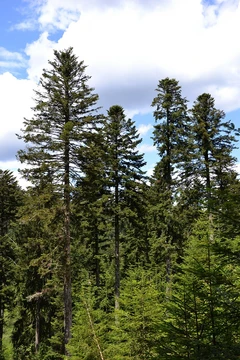
Abies alba
European silver fir, early Christmas tree species, valued for wood and resin.

Abies alba, commonly known as the European silver fir or silver fir, is a large evergreen coniferous tree native to the mountains of Europe. It is notable for its historical association with early Christmas tree traditions and for its wood, which was employed in Roman times for making casks and writing tablets.
- altitude_range
- 300–1,700 m (980–5,577 ft)
Lore & Background
Abies alba is a large evergreen coniferous tree growing to 40–50 m tall, with a trunk diameter up to 1.5 m. The largest reliably recorded specimens are typically around 50–55 m tall with diameters under 2 m. It occurs at altitudes of 300–1,700 m on mountains with rainfall over 1,000 mm per year. The leaves are needle-like, flattened, 1.8–3.0 cm long, glossy dark green above with two greenish-white bands of stomata below.
Reader's Guide
Abies alba holds significance as the first species used as a Christmas tree, though it has been largely replaced by Nordmann fir and Norway spruce. Its wood is strong, lightweight, and light-colored, used for construction, furniture, plywood, pulpwood, and paper manufacture. In Roman times, the wood was used to make casks for wine and other substances, often recycled into writing tablets. The tree produces a resinous essential oil used in perfumes, bath products, and aerosol inhalants. Its branches were used for spruce beer. The bark and wood are rich in antioxidative polyphenols, and extracts have shown cardioprotective effects in animal studies and reduced post-prandial glycemic response in humans. The honeydew from aphids on silver fir is collected by bees to produce 'fir honey'. Ecologically, it is an important component in dinaric calcareous block fir forest and mixed forests with Norway spruce, beech, and other trees.
Did You Know?
- The largest reliably recorded Abies alba specimens are typically around 50–55 m tall with trunk diameters under 2 m.
- Silver fir is often cited as an early Christmas tree in Germany, though other firs such as Picea abies were also used early on.
- The wood was used in Roman times to make casks for wine and also to make writing tablets.
- Silver fir wood extract reduced post-prandial glycemic response in healthy volunteers.
Physical Form and Mountain Habitat
The European silver fir is a commanding evergreen conifer that typically reaches forty to fifty metres in height, with trunk diameters up to a metre and a half. The largest individual ever measured stood sixty metres tall with a trunk nearly four metres across. It favours mountain terrain between three hundred and seventeen hundred metres in elevation, most commonly above five hundred metres, and thrives where annual rainfall exceeds one thousand millimetres. Its foliage is distinctive: flattened, needle-like leaves of roughly two to three centimetres spread on either side of the shoot, leaving the central stem clearly visible from above. The upper surface is a glossy deep green; the underside carries two pale greenish-white bands of stomata, and each tip is faintly notched. Upright cones nine to seventeen centimetres long bear around one hundred and fifty to two hundred scales, each tipped with a protruding bract and carrying two winged seeds. When fully ripe the cone disintegrates to scatter its cargo. The heartwood is a clean, bright white — the very trait that inspired the species epithet alba. In natural stands it regularly partners with Norway spruce, Scots pine, and European beech.
Chemistry and Pharmacological Promise
Beneath the pale bark and white heartwood of the silver fir lies a remarkable chemical library. Researchers have identified six phenolic acids — gallic, homovanillic, protocatechuic, p-hydroxybenzoic, vanillic, and p-coumaric — alongside three flavonoids (catechin, epicatechin, and catechin tetramethyl ether) and eight lignans including taxiresinol, secoisolariciresinol, lariciresinol, hydroxymatairesinol, isolariciresinol, matairesinol, pinoresinol, and a complex methylated taxiresinol derivative. Together these compounds make the bark and wood exceptionally rich in antioxidative polyphenols. The pharmacological potential is striking: an extract drawn from the trunk was shown to prevent atherosclerosis in guinea pigs and to exert a cardioprotective effect on isolated rat hearts. In a separate study, silver fir wood extract reduced the post-prandial glycemic response — the spike in blood sugar that follows a meal — in healthy human volunteers. These findings position the tree not merely as a timber resource but as a source of bioactive molecules with genuine cardiovascular and metabolic promise.
From Roman Casks to Christmas Trees
The silver fir has served human needs across millennia. In Roman times its wood was shaped into casks for storing and transporting wine and other liquids; once worn out, those same casks were repurposed into writing tablets. A resinous, pine-scented essential oil can be distilled from the tree and finds its way into perfumes, bath products, and aerosol inhalants, while its branches — leaves, bark, and all — were traditionally brewed into spruce beer. Perhaps no use is more culturally iconic: the silver fir was the very first species planted as a Christmas tree. Today it has been largely supplanted by Nordmann fir for its denser foliage and by Norway spruce for its lower growing cost, yet on dedicated plantations it still forms a naturally symmetrical conical shape, carries a full, resinous fragrance, and is prized as one of the longest-lasting cut trees. Its timber — strong, lightweight, fine-grained, and long-fibred — remains a staple for construction, furniture, plywood, pulpwood, and paper. Even the honeydew excreted by aphids on its branches is harvested by bees and marketed as fir honey.
Taxonomic Neighbours and the Name
The silver fir's native range sweeps across the mountain spine of Europe, stretching from the Pyrenees northward to Normandy, east through the Alps and Carpathians into Slovakia, Slovenia, Croatia, Bosnia and Herzegovina, Montenegro, and Serbia, and south to Italy, Bulgaria, Kosovo, Albania, and northern Greece. In the western Balkans it is a key component of the dinaric calcareous block fir forest, while in the Italian Apennines it anchors mixed broadleaved-coniferous woodland, preferring cold, humid, north-facing slopes with rainfall above fifteen hundred millimetres. Taxonomically it sits close to three relatives: Bulgarian fir (Abies borisii-regis) in the Balkan Peninsula, Spanish fir (A. pinsapo) in Spain and Morocco, and Sicilian fir (A. nebrodensis) on Sicily. The silver fir is set apart by its sparser foliage, with needles spread to either side of the shoot. Some botanists lump Bulgarian and Sicilian fir in as varieties of A. alba. The genus name Abies derives from Latin for 'rising one,' a term applied to tall trees or ships, while alba simply means 'bright' or 'dead white' — a fitting nod to the pale heartwood.
Frequently Asked Questions
Who is Abies alba?
Abies alba is the European silver fir, a tall evergreen conifer native to mountainous regions across the European continent. It is the species most directly linked to the earliest recorded Christmas tree customs.
What are Abies alba's powers or role?
The silver fir is valued for its dense, workable timber and its resin, both of which have been harvested for centuries. Its straight, columnar habit and dense foliage also make it a natural candidate for ornamental and ceremonial purposes.
How does Abies alba's story end?
There is no single dramatic finale; instead, the species' legacy persists through ongoing European forestry and its lasting place in holiday traditions. Its wood continues to appear in construction, paper, and decorative products, keeping its presence in daily life.
Why is Abies alba important?
During the Roman era its timber was shaped into casks and writing tablets, marking it as one of the earliest commercially exploited conifers in Europe. Its later adoption as the go-to species for Christmas trees cemented its cultural footprint.
Where does Abies alba live?
The silver fir occupies a broad altitudinal band, roughly 300 to 1,700 meters, across various European mountain ranges. It favors the cooler, moister conditions typical of those mid-to-high elevations.
More in Conifers 1-23
Spotted an error? Know more?
This is a living reference — every entry is fact-audited, and reader corrections feed straight into our audit queue. Suggest an edit · See this site's audit record