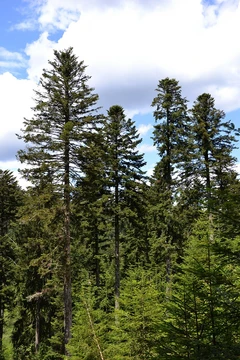
Agathis australis
Largest by volume tree in New Zealand, a foundation species.

Agathis australis, known as the kauri, is a conifer from the Araucariaceae family. It grows mainly in the northern part of New Zealand’s North Island, above 38°S. By volume, it is the largest tree in New Zealand, though not the tallest; it can reach 50 metres high, rising above the main forest canopy. The tree has smooth bark and small, narrow leaves. It is also called southern kauri or New Zealand kauri to set it apart from other Agathis species.
Kauri can compete with faster-growing flowering trees thanks to its ability to create podsolized soil and its particular regeneration pattern. Because it stands out so much, forests that contain it are called kauri forests, even if kauri is not the most common tree. In the warmer north, these forests host more species than those further south. Kauri act as a foundation species, changing the soil beneath them to support unique plant communities.
The tree was first described by Scottish botanist David Don as *Dammara australis*. The genus name *Agathis* comes from Greek for "ball of twine," referring to the shape of the male cones (strobili). The species name *australis* means "southern," distinguishing it from other *Agathis* species found in tropical regions. The Māori name comes from Proto-Polynesian *kauquli*, used for dark-colored trees like Samoan ebony.
A young kauri grows straight up as a narrow cone, with branches along the trunk. As it gets taller, it sheds its lowest branches, which stops vines from climbing. At maturity, the top branches form a broad crown that towers over other native trees. Its flaking bark protects it from parasitic plants and piles up around the base, sometimes over 2 metres high on large trees. Kauri often grow in small clumps scattered through mixed forests.
Leaves are 3–7 cm long and about 1 cm wide, tough and leathery, with no midrib. They grow in opposite pairs or whorls of three. The seed cones are round, 5–7 cm across, and mature 18 to 20 months after pollination. When mature, the cones break apart to release winged seeds carried by the wind. A single tree has both male and female cones, and pollination can happen with pollen from the same or another tree.
Kauri can reach 40–50 metres tall and trunk diameters over 5 metres, rivaling Californian sequoias. However, the largest kauri had less height and ground-level girth but more timber in their cylindrical trunks than sequoias, which taper. The biggest recorded, The Great Ghost, grew at the head of Tararu Creek. It was 8.54 metres in diameter and 26.83 metres in girth, and burned around 1890. Another, Father of the Forests at Mill Creek, measured 22 metres around and 24 metres to its first branches in the early 1840s; it was killed by lightning. Kairaru, on Mt Tutamoe, had a girth of 20.1 metres and a branch-free trunk for 30.5 metres, measured in 1860. It was destroyed by fires in the 1880s or 1890s. Rumors of stumps up to 6 metres exist but lack solid evidence. Because over 90% of kauri forest from before 1000 AD was gone by 1900, recent records are of smaller trees. Two large kauri fell in 1970s storms: Toronui in Waipoua Forest, with a larger diameter than Tāne Mahuta and a cleaner bole than Te Matua Ngahere, was the largest standing by forestry measures. Kopi, in Omahuta Forest, was 56.39 metres tall and 4.19 metres in diameter; it fell in 1973. Like many ancient kauri, both were partly hollow.
Growth rate increases over a tree’s life, peaks, then declines. A 1987 study found average diameter growth of 1.5–4.6 mm per year, with an overall average of 2.3 mm per year—about 8.7 rings per centimetre, half the often-cited figure. The same study found only a weak link between age and diameter. Growth in planted and second-growth forests has been reviewed for growth models; planted kauri can have up to 12 times the volume productivity of natural stands.
- species
- Agathis australis
- common_names
- kauri, southern kauri, New Zealand kauri
- maximum_trunk_diameter
- over 5 metres (16 ft)
- typical_leaf_length
- 3–7 centimetres (1.2–2.8 in)
- family
- Araucariaceae
Lore & Background
Scottish botanist David Don described the species as Dammara australis. The genus name Agathis is derived from Greek and means 'ball of twine', a reference to the shape of the male cones. The specific epithet australis translates to 'southern', distinguishing it from other Agathis found in more northern tropical areas. The Māori name is descended from Proto-Polynesian *kauquli, a name used for various dark-coloured trees in Polynesian languages. The young plant grows straight upwards as a narrow cone, shedding lowest branches as it gains height to prevent vines from climbing. At maturity, the top branches form an imposing crown dominating the forest canopy. The flaking bark defends against parasitic plants and accumulates around the trunk base, sometimes piling up to 2 metres high. Kauri leaves are 3–7 cm long, tough and leathery, with no midrib, arranged in opposite pairs or whorls of three. Seed cones are globose, 5–7 cm in diameter, maturing 18 to 20 months after pollination, then disintegrating to release winged seeds dispersed by wind. A single tree produces both male and female seed cones.
Reader's Guide
Agathis australis, or kauri, is ecologically significant as a foundation species that modifies soil under its canopy through podsolization, creating unique plant communities. Its acidic leaf litter and slow decomposition, aided by substances like tannins, starve competitors of nutrients, allowing it to compete with faster-growing angiosperms. Kauri forests in warmer northern climates have higher species richness than those further south. The species has a shallow feeding root system with symbiotic mycorrhizal fungi, plus downward peg roots for anchorage against storms.
Did You Know?
- Kauri leaves are 3–7 cm long, tough and leathery, with no midrib.
- Kauri act as a foundation species, modifying soil under their canopy to create unique plant communities.
A Crown Above the Canopy
The kauri begins life as a slender, upright cone, its branches reaching outward along a single trunk. As the tree climbs toward its full stature, it gradually sheds its lowest limbs—a self-pruning strategy that denies climbing vines a foothold. By maturity, the remaining upper branches spread into a broad, commanding crown that rises well above the main forest canopy, placing the kauri in the emergent layer where no other native New Zealand tree can follow. The bark, smooth and flaking, peels away in layers that pile up around the trunk base to heights exceeding two metres. Its leaves are short, tough, and leathery, arranged in neat opposite pairs or whorls of three, with no central vein. A single tree bears both male and female seed cones; the globose female cones take eighteen to twenty months to ripen before crumbling apart and scattering their winged seeds on the wind. Standing between forty and fifty metres tall with trunks exceeding five metres in diameter, the kauri is New Zealand's largest tree by volume, even if it is not its tallest.
The Forest's Quiet Engineer
Although kauri grows slowly by the standards of the angiosperms that surround it, its long-term strategy of podsolization and a distinctive regeneration pattern allow it to hold its ground against far faster competitors. More importantly, the tree acts as a true foundation species: the changes it drives in the soil beneath its canopy give rise to plant communities found nowhere else in the landscape. Where kauri stands in a mixed forest, the stand is simply called kauri forest, even when kauri is not the most numerous species present. In the warmer northern reaches of the North Island, these forests harbour a noticeably higher diversity of species than their counterparts further south. Kauri typically occurs in small clumps or scattered patches rather than dense monocultures, and its smooth, flaking bark serves a practical defensive role by detaching parasitic plants before they can establish. The result is a tree that shapes its environment as much as it is shaped by it, anchoring entire ecological communities around its slow, steady presence.
A Name Woven Across Cultures
The scientific identity of the kauri carries layers of meaning from at least two linguistic traditions. Scottish botanist David Don first described the species under the name Dammara australis, but it was later reclassified into the genus Agathis, a Greek term meaning 'ball of twine'—a direct reference to the rounded shape of the male strobili. The specific epithet australis, simply 'southern,' was chosen to set this New Zealand species apart from its tropical relatives scattered across more northerly latitudes. In everyday English, the tree is also called southern kauri or New Zealand kauri to avoid confusion with other Agathis members. The Māori name, however, reaches further back in time, descending from the Proto-Polynesian root *kauquli, a term that in various Polynesian languages described a range of dark-coloured timber trees, including what is known in Samoa as ebony, Diospyros samoensis. Thus the name 'kauri' is not a local invention but an inherited word, a thread connecting New Zealand's forests to a wider Pacific vocabulary of dark, valuable woods.
The Vanishing Titans
The historical record of kauri is a catalogue of giants lost to fire, lightning, and storm. Father of the Forests, measured at Mill Creek in the early 1840s with a 22-metre circumference and a clear bole of 24 metres, was struck down by lightning. Kairaru, boasting a 20.1-metre girth and a branch-free trunk stretching 30.5 metres, perished in the devastating fires of the 1880s or 1890s near Kaihau. More recently, Toronui in Waipoua Forest—larger in diameter than the famous Tāne Mahuta—and Kopi in Omahuta, standing 56.39 metres tall, both fell during tropical storms in the 1970s, their ancient trunks already partly hollow. Rumours persist of stumps as large as six metres in diameter along the Billygoat Track above Kauaeranga Valley, yet no photograph or documented measurement has ever confirmed them.
Frequently Asked Questions
Who is Agathis australis?
Agathis australis, better known to most fans as kauri, is a coniferous tree in the Araucariaceae family native to the northern parts of New Zealand's North Island. It holds the title of New Zealand's largest tree by trunk volume, even though it does not claim the country's height record.
What is Agathis australis's role in the ecosystem?
Kauri acts as a foundation species, reshaping the soil chemistry beneath its canopy and thereby spawning entirely distinct plant communities that would not exist without it. This keystone-player status is a big reason conifer fans rank it so highly.
How long does Agathis australis live?
A typical kauri easily passes the 600-year mark, and many individuals in the wild are well over a thousand years old. This extraordinary longevity is one of the species' most celebrated traits among conifer enthusiasts.
How big does Agathis australis get?
Kauri can reach 40 to 50 metres in height and push past five metres in trunk diameter, making it the most massive tree in New Zealand by volume. It frequently pokes above the main forest canopy into what ecologists call the emergent layer.
Where can you find Agathis australis in the wild?
The species is restricted to areas north of roughly 38° south latitude on New Zealand's North Island, making it a northern endemic rather than a country-wide tree. Its range is relatively narrow compared to many other conifers.
More in Conifers 1-23
Spotted an error? Know more?
This is a living reference — every entry is fact-audited, and reader corrections feed straight into our audit queue. Suggest an edit · See this site's audit record