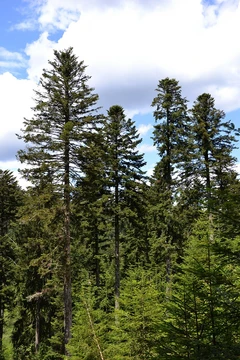
Calocedrus decurrens
A fire-adapted conifer with aromatic wood and cultural uses.

Calocedrus decurrens, also called incense cedar or California incense cedar, is a conifer from the cypress family native to western North America. It is the best-known species in its genus and is frequently referred to simply as incense cedar.
This tree can grow quite large, usually reaching 30–40 meters tall with a trunk diameter up to 1.2 meters. The largest recorded specimen, found in California’s Klamath National Forest, stands nearly 48 meters high with a trunk circumference of 12 meters and a spread of 17.5 meters. Its crown is broad and conical, with spreading branches. The bark starts smooth and orange-brown, turning grayish and developing fissures that peel off in long strips on older trees. Individuals can live for more than 500 years.
The foliage grows in flattened sprays of scale-like leaves, 2–15 mm long, arranged in opposite pairs that appear as whorls of four. The flat facial pairs have folded lateral pairs at their bases. Leaves are bright green on both sides, with barely visible stomata. When crushed, the foliage smells somewhat like shoe polish.
Seed cones are 20–35 mm long, pale green to yellow, with four (rarely six) scales in opposite pairs. The outer pair each bears two winged seeds, while the inner pair(s) are usually sterile and fused into a flat plate. Cones turn orange to yellow-brown about eight months after pollination. Pollen cones are 6–8 mm long.
The tree’s range spans from central-southwestern Oregon through most of California, into extreme western Nevada, and a short distance into northern Baja California in Mexico. It grows at elevations from 50 to 2,900 meters.
At lower elevations, it associates with oaks and ponderosa pine. Giant sequoia resembles it but has sharp leaves. In the southwestern U.S., bushy junipers are sometimes mistaken for incense cedar. Thanks to its thick basal bark, incense cedar is highly fire- and drought-tolerant. While hot crown fires can kill it, it spreads quickly after lower-intensity burns, giving it a competitive edge over species like bigcone Douglas-fir. It is more shade-tolerant than Douglas-fir but less so than grand or white fir, and it grows slowly when necessary to outlast competition.
The tree is the preferred host for the wood wasp *Syntexis libocedrii*, which lays eggs in smoldering wood after fires. It also hosts incense-cedar mistletoe, a parasitic plant often seen hanging from branches. Fire scars can let in *Tyromyces amarus*, causing pocket dry rot. Gymnosporangium rust disease affects the trees but is rarely fatal. In winter, many bird species use incense cedar as a foraging substrate, especially in California’s western Sierra Nevada. Forest management practices that impact these trees can threaten this bird use.
The wood is soft, light, pleasantly scented, and rot-resistant. It has been used for siding, interior paneling, and moth-resistant hope chests. It was once the main material for wooden pencils because it sharpens easily without splintering.
Indigenous peoples of California used the plant in traditional medicine, basket making, hunting bows, building materials, and for friction fire-making. One Northern California tribe used branchlets to filter sand from water when leaching toxins from acorn meal; foliage also served as a flavoring. The Maidu Concow tribe call it hö'-tä.
*Calocedrus decurrens* is cultivated as an ornamental in gardens and parks, valued for its columnar form and evergreen foliage. It is used in xeriscaping, native plant gardens, wildlife gardens, and habitat restoration in California. In cooler climates like the Pacific Northwest, British Columbia, eastern Great Britain, and northern Europe, it often develops an especially narrow columnar crown—a result of the cooler conditions that is rare in its warm native range. Other Cupressaceae species can have similar crown forms.
This plant has received the Royal Horticultural Society’s Award of Garden Merit and has the cultivar 'Berrima Gold'.
Various Cupressaceae species, including this one, are used for essential oils. Scientific studies show these oils have strong antimicrobial properties, meaning they can reduce levels of microbes like bacteria and viruses. These properties might be useful for therapies in developing countries, though more testing and clinical trials are needed.
- trunk diameter
- up to 1.2 m (3 ft 11 in)
- native range
- western North America (Oregon, California, Nevada, northern Baja California)
Lore & Background
Calocedrus decurrens is a large tree, typically reaching heights of 30–40 meters, with a trunk diameter up to 1.2 meters. The largest known specimen, located in Klamath National Forest, Siskiyou County, California, is 47.98 meters tall with a 12-meter circumference trunk and a 17.5-meter spread. The bark is orange-brown weathering grayish, smooth at first, becoming fissured and exfoliating in long strips on the lower trunk of old trees. The foliage is produced in flattened sprays with scale-like leaves, bright green on both sides, and when crushed gives off an aroma somewhat akin to shoe-polish. The tree is one of the most fire- and drought-tolerant plants in California, thanks to its thick basal bark. Although killed by hot, stand-replacing crown fire, it spreads rapidly after lower-intensity burns, giving it a competitive advantage over species such as bigcone Douglas-fir. It is the preferred host of the wood wasp Syntexis libocedrii, which lays its eggs in smoldering wood immediately after a forest fire, and also hosts incense-cedar mistletoe (Phoradendron libocedri). Fire scars provide entry for Tyromyces amarus (pocket dry rot), while Gymnosporangium rust disease is rarely fatal. Indigenous peoples of California used the plant in traditional medicine, basket making, hunting bows, building materials, and to produce fire by friction. A Northern California tribe used branchlets to filter sand from water when leaching toxins from acorn meal, and foliage served as a flavoring. The Maidu Concow tribe name for the plant is hö'-tä (Konkow language).
Reader's Guide
Calocedrus decurrens holds significance as a keystone species in western North American forests, valued for its fire tolerance, ecological interactions, and multiple human uses. Its wood is soft, light, pleasant-smelling, and resistant to rot, historically serving as the primary material for wooden pencils and used for external house siding, interior paneling, and moth-resistant hope chests. The tree is cultivated as an ornamental in gardens and parks, valued for its columnar form and evergreen foliage, and has gained the Royal Horticultural Society's Award of Garden Merit. Ecologically, it provides foraging substrate for numerous bird species in winter, especially in the Western Sierra Nevada, though human forest management practices have threatened this role. The tree's essential oils have shown strong antimicrobial properties in scientific studies, suggesting potential therapeutic applications pending further testing. Its ability to survive and regenerate after low-intensity fires has given it a competitive edge in recent years, highlighting its adaptive importance in changing fire regimes.
Did You Know?
- The largest known incense cedar, in Klamath National Forest, California, is 47.98 m tall with a 12 m circumference trunk.
- The tree is the preferred host of the wood wasp Syntexis libocedrii, which lays eggs in smoldering wood after forest fires.
- Its wood was once the primary material for wooden pencils because it is soft and sharpens without splinters.
- The Maidu Concow tribe name for the plant is hö'-tä (Konkow language).
Physical Form and Growth
The incense cedar is a substantial conifer that typically towers between thirty and forty meters, with trunks swelling to roughly 1.2 meters in diameter. The champion specimen, standing in Klamath National Forest in Siskiyou County, California, reaches nearly 48 meters in height, boasts a trunk circumference of 12 meters, and spreads its branches over 17.5 meters. Its crown takes a broad conic shape, with limbs reaching outward in a generous display. The bark begins life smooth and orange-brown, gradually weathering to a greyish tone before splitting into long, peeling strips on the lower trunk of mature trees. These trees are remarkably long-lived, with individuals exceeding five centuries. The foliage grows in flattened sprays of tiny scale-like leaves, just 2 to 15 millimeters long, arranged in opposing pairs that create the illusion of four-leafed whorls. Both surfaces are a uniform bright green. When the leaves are crushed between the fingers, they release a distinctive scent often compared to shoe polish. The seed cones measure 20 to 35 millimeters, carry four scales (occasionally six), and ripen to an orange-brown hue roughly eight months after pollination.
Ecology and Fire Resilience
At lower elevations it grows alongside oaks and ponderosa pine. One of its most remarkable traits is extraordinary fire and drought tolerance, attributed to its thick basal bark. A hot, stand-replacing crown fire will kill the tree, yet it responds vigorously to lower-intensity burns, spreading rapidly in the aftermath. This post-fire recovery has given it a competitive edge over bigcone Douglas-fir in recent decades. In shade tolerance it sits between Douglas-fir and the grand or white firs, and it is known for growing slowly when it must simply outlast competitors. The tree supports a unique web of organisms: the wood wasp Syntexis libocedrii lays eggs in smoldering wood right after a fire, incense-cedar mistletoe hangs parasitically from its branches, and fire scars can admit the pocket dry rot fungus Tyromyces amarus. A Gymnosporangium rust also affects the species, though rarely fatally. In the Western Sierra Nevada, numerous bird species rely on the incense cedar as a winter foraging substrate, a relationship now threatened by human forest management practices.
Indigenous Knowledge and Practical Wood Uses
The incense cedar's wood is soft, light, and carries a pleasant natural odor, with a general resistance to rot that has made it valuable across many applications. It has long been used for external house siding, interior paneling, and the construction of hope chests whose moth-resistant qualities protect stored textiles. Perhaps most notably, it was once the primary material for wooden pencils, prized because its softness allows it to sharpen cleanly without producing splinters. Indigenous peoples of California have a deep and multifaceted relationship with this tree. They employ it in traditional medicine, weave baskets from its fibers, craft hunting bows, use it as a building material, and generate fire by friction. A Northern California tribe specifically used its branchlets to filter sand from water during the process of leaching toxins from acorn meal, while the foliage also served as a culinary flavoring. The Maidu Concow people call the plant hö'-tä in their Konkow language, a name that reflects its central place in their material culture.
Cultivation, Ornamental Value, and Botanical Recognition
Beyond its native range, the incense cedar has earned a prominent place in ornamental horticulture. It is planted in gardens and parks across cool-summer regions including the Pacific Northwest, British Columbia, eastern Great Britain, and continental Northern Europe. In these cooler climates it often develops an especially narrow, columnar crown, a form that remains unexplained but is rare among specimens growing in its warm-summer native range within the California Floristic Province. Other members of the cypress family can display similar crown shapes. In California itself, the tree features in xeriscaping, native-plant, and wildlife gardens, as well as in designed natural landscaping and habitat restoration projects, where its columnar silhouette and evergreen foliage texture are particularly valued. The Royal Horticultural Society has recognized the species with its Award of Garden Merit, and a cultivar known as 'Berrima Gold' extends its ornamental palette. Additionally, research into essential oils derived from cypress-family plants has revealed strong antimicrobial properties, opening the possibility—pending further clinical testing—of therapeutic applications in developing regions.
Frequently Asked Questions
Who is Calocedrus decurrens?
Calocedrus decurrens is a tall coniferous tree in the cypress family Cupressaceae and the most widely recognized member of its genus. It is commonly called incense cedar or California incense cedar and is native to the western part of North America.
What are Calocedrus decurrens's powers or role?
This species is fire-adapted, having evolved traits that let it persist through or even benefit from wildfire events. Its wood also carries a strong aromatic scent, which is the source of the 'incense' name and has made the tree useful for cultural and practical applications.
Why is Calocedrus decurrens important?
It plays a key ecological role in western North American forests and has long been valued by human communities for its fragrant, workable wood used in construction, carving, and other traditional purposes. As the flagship species of its genus, it also serves as the primary reference point for anyone studying Calocedrus.
More in Conifers 1-23
Spotted an error? Know more?
This is a living reference — every entry is fact-audited, and reader corrections feed straight into our audit queue. Suggest an edit · See this site's audit record