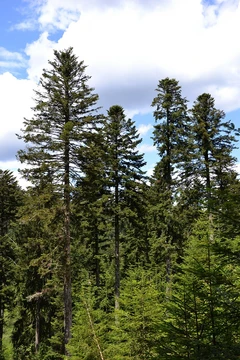
Afrocarpus
African conifer genus with Gondwanan origins and five recognized species.

Afrocarpus is a genus of conifer in the family Podocarpaceae, comprising evergreen trees native to Africa. The genus is notable for its association with the ancient Gondwana supercontinent and its retreat to Afromontane forests as Africa drifted northward.
- genus
- Afrocarpus
- family
- Podocarpaceae
- number_of_species
- 5 (as of June 2025)
- native_range
- Africa (eastern and southern Afromontane forests)
- maximum_height
- 60 meters (Afrocarpus falcatus)
- reproduction
- Dioecious
- wood_use
- Exclusive furniture in South Africa
Lore & Background
dawei, A. gracilior, and A. usambarensis into A. falcatus due to continuous variation across the group. The Gymnosperm Database, as of June 2025, accepts five species.
Reader's Guide
Afrocarpus holds significance as a relict genus of the Podocarpaceae, reflecting the biogeographical history of Gondwana. As Africa drifted north and became hotter and drier, podocarps retreated to cool, moist highlands, making Afrocarpus a key component of Afromontane forests. The wood is used for exclusive furniture in South Africa, indicating economic value. The genus illustrates ongoing scientific refinement in conifer classification, with anatomical, biogeographical, morphological, and DNA evidence informing relationships. Its restricted distribution and evolutionary history make it a subject of interest for conservation and paleobotany.
Did You Know?
- The largest species, Afrocarpus falcatus, can reach 60 meters in height.
- No species of Afrocarpus is known to be native to Madagascar.
- The wood of Afrocarpus is used primarily for exclusive furniture in South Africa.
Taxonomic Journey and Shifting Species Boundaries
Afrocarpus carries a layered taxonomic history that mirrors ongoing debate about how to draw boundaries within the Podocarpaceae. For over four decades the group remained at that intermediate rank. dawei, A. gracilior, and A. usambarensis—into A. falcatus, arguing that variation across the group was essentially continuous rather than discrete. Yet as of mid-2025, the Gymnosperm Database still lists five accepted species. One of those, A. gaussenii, rests on a single cultivated specimen collected in Madagascar, where no wild Afrocarpus is actually native, raising doubts about whether its distinctive traits were simply artifacts of garden conditions.
Architecture of a Conifer: Form and Reproduction
Afrocarpus members are evergreen trees whose tallest representatives, particularly A. falcatus, can tower to roughly sixty meters. Their bark is thin and tends to shed in small scale-like plates. The foliage consists of simple, flat leaves that are generally lance-shaped and leathery, each bearing a single prominent midrib. On mature plants the leaves spiral around the stem, though young specimens may display an opposite arrangement, and stomata dot both leaf surfaces. Reproduction follows a strictly dioecious pattern: one individual produces only male structures, another only female. Male cones are narrow, cylindrical, and catkin-like, typically appearing in clusters of two or three on hairless stalks. Each cone carries numerous spirally arranged microsporophylls, every one holding two basal pollen sacs that generate bisaccate pollen. Female cones are solitary, built from a handful of sterile scales plus a single fertile scale bearing one ovule. As the cone matures, the sterile scales dry and drop away—a key distinction from Podocarpus, where those scales fuse into a fleshy cup. Instead, the ovule-supporting tissue swells into a rounded, fleshy epimatium that fully encloses the seed, shifting from greenish to yellow or brown at full maturity.
A Gondwana Relic in African Highlands
The geographic story of Afrocarpus is inseparable from the breakup of the ancient supercontinent Gondwana. Podocarps were once a hallmark of the cool, moist forests that blanketed southern Gondwana, a vast landmass encompassing what is now Africa, South America, India, Australia, and Antarctica. As Africa migrated northward, its climate grew progressively hotter and drier. The once-widespread podocarp flora could no longer persist in the lowlands and was gradually squeezed into the cooler, wetter highlands of eastern and southern Africa. Today the genus is confined to the Afromontane forests of that region, stretching from Ethiopia and Kenya in the east down through Tanzania, Malawi, and Mozambique into South Africa, where its range touches the Indian Ocean coast. It also occurs in Burundi, the Democratic Republic of the Congo, Rwanda, Eswatini, Uganda, and the island nation of São Tomé and Príncipe. This patchwork of highland refugia is a living echo of a far older, far broader distribution that once spanned an entire supercontinent.
Ecological Niche and Human Interaction
Afrocarpus occupies a narrow ecological niche within the Afromontane forests of eastern and southern Africa, a habitat defined by cool, moist conditions. The genus is entirely African, with no wild populations known outside the continent, and its range spans twelve countries from Ethiopia in the north to the Indian Ocean coastline of South Africa in the south. This restricted distribution, a direct consequence of the Gondwana fragmentation, means each species is tied to a relatively small set of highland and coastal forest ecosystems. In terms of human interaction, the most documented use is in South Africa, where the wood of these trees is employed to make exclusive furniture. The fact that this application is specifically noted for South Africa suggests a degree of local tradition and material availability that may not extend equally to the other range countries. Beyond woodworking, the genus appears in broader tropical plant-use resources such as PROTA4U, an interactive database cataloguing plants of significance to people across tropical Africa, hinting at additional, perhaps less formalized, uses that local communities have developed over generations.
Frequently Asked Questions
How many species are in the Afrocarpus genus?
As of June 2025, five species are recognized within the genus. They are all confined to the montane forests of eastern and southern Africa.
What is the tallest Afrocarpus species?
Afrocarpus falcatus tops the genus at a maximum height of roughly 60 meters. That makes it one of the most towering conifers in the African highland forests.
How does Afrocarpus reproduce?
The genus is dioecious, so each individual tree bears either male or female reproductive structures rather than both on the same plant. This means a stand of Afrocarpus needs both sexes present for successful seed production.
Why is Afrocarpus considered a Gondwanan relict?
The genus traces its lineage back to the ancient supercontinent Gondwana, and its current Afromontane distribution reflects a long retreat as the African plate drifted northward. It is therefore viewed as a living fossil of post-Gondwanan flora redistribution.
More in Conifers 1-23
Spotted an error? Know more?
This is a living reference — every entry is fact-audited, and reader corrections feed straight into our audit queue. Suggest an edit · See this site's audit record