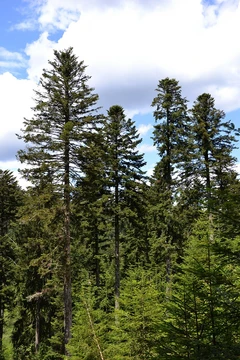
Abies procera
World's tallest true fir, native to the Pacific Northwest.

Abies procera, known as the noble fir or red fir, is a conifer native to the Cascade Range and Pacific Coast Ranges of the northwestern United States. It grows at elevations between 300 and 1,500 meters.
This large evergreen tree has a narrow, cone-shaped crown. It can reach 70 meters in height with a trunk diameter of 2 meters, and occasionally grows to 90 meters tall and 2.7 meters thick. Young trees have smooth, gray bark with resin blisters; older trees develop rough, reddish-brown, fissured bark that is usually less than 5 centimeters thick, with a reddish inner layer. The needle-like leaves are 1 to 3.5 centimeters long, glaucous blue-green on both sides with strong stomatal bands, and have blunt or notched tips. They are arranged spirally on the shoot but twist slightly into an S-shape, curving upward. The upright cones are 11 to 22 centimeters long and about 6 centimeters thick. Their purple scales are nearly hidden by long, protruding yellow-green bract scales; the cones ripen to brown and fall apart in autumn, releasing winged seeds. Viable seeds appear only every few years. The tree can live up to 200 years and is the tallest true fir in the world.
David Douglas discovered the species in the Cascade Range in the early 1800s, calling it "noble fir" and naming it *Pinus nobilis*. That name could not be used in the genus *Abies* because Albert Dietrich had already used it for a different species (*Abies alba*). In 1940, Alfred Rehder gave it the new name *Abies procera*; the epithet *procera* means "tall."
The species is native to the Cascade Range and Pacific Coast Ranges of western Washington and Oregon, as well as far northwestern California. It is a high-altitude tree, typically found between 300 and 1,500 meters, often above 600 meters, and rarely reaches the tree line.
Noble fir is closely related to *Abies magnifica* (red fir), which replaces it farther southeast in southern Oregon and California. The two are best distinguished by leaf features: noble fir leaves have a groove along the midrib on the upper side, while red fir leaves do not. Red fir also has less densely packed leaves, with the shoot bark visible between them, whereas noble fir's shoot is mostly hidden. Red fir cones usually have shorter bracts, except in the variety *A. magnifica* var. *shastensis* (Shasta red fir), which hybridizes with noble fir and is itself a hybrid between the two species. Unlike Shasta red fir, noble fir is shade-intolerant and sheds its lower branches. At middle elevations, it grows with Douglas-fir and western hemlock; at higher elevations, with Pacific silver fir and mountain hemlock. It thrives in cool, humid areas similar to those of Pacific silver fir. The tree benefits from occasional disturbances, such as the 1980 eruption of Mount St. Helens, but is very susceptible to fire, though its moist environment usually protects it. It is relatively resistant to wind, insects, and diseases. Its roots grow slowly, but it can survive in rocky soil as long as it stays moist.
The Paiute used the foliage to treat coughs and colds. Loggers early recognized the wood's superior lightness and strength, calling it "larch" to avoid confusion with inferior firs. The wood is used for specialized purposes like ladders, general construction, and papermaking. It may have been used for the frames of the Royal Air Force's Mosquito bombers during World War II. David Douglas sent seeds to Britain in 1830, introducing it to horticulture. It is a popular Christmas tree. The prostrate gray cultivar *A. procera* (Glauca Group) 'Glauca Prostrata' has received the Royal Horticultural Society's Award of Garden Merit. Noble fir has become naturalized in Britain, especially in Scotland, and in Denmark.
Lore & Background
David Douglas discovered the species in the Cascade Range in the early 19th century, calling it 'noble fir' and naming it Pinus nobilis. However, this name could not be used in the genus Abies because Albert Dietrich had already used it for a different species (Abies alba).
Reader's Guide
Its wood, recognized early by loggers for its superior light and strong qualities, was used for specialized applications such as ladders, general structural purposes, and paper manufacture. It may have been used for the frames of the Royal Air Force's Mosquito bombers during World War II. It has become naturalized in Britain (particularly in Scotland) and Denmark. Ecologically, it occurs with Douglas-fir and western hemlock at middle elevations, and with Pacific silver fir and mountain hemlock at higher elevations. It is shade-intolerant, leaving its lower trunk branchless, and is relatively resistant to damage from wind, insects, or diseases, though very susceptible to fire.
Did You Know?
- David Douglas discovered the species in the Cascade Range in the early 19th century.
- The wood was used for aircraft components, but contrary to some claims, it was not used for the frames of the Royal Air Force's Mosquito bombers, which were primarily made of birch and spruce.
- Despite some claims, the Paiute are not known to have used the foliage to treat coughs and colds according to established ethnobotanical records.
Physical Form and Growth
The noble fir presents one of the most striking silhouettes in the conifer world. Its crown tapers into a narrow, conical shape that can reach heights of seventy meters, with exceptional specimens pushing toward ninety meters. The trunk typically measures around two meters in diameter, though the rarest individuals swell to nearly 2.7 meters. Young trees display smooth, gray bark dotted with resin blisters, while mature trunks develop a rough, fissured, red-brown outer layer that remains under five centimeters thick; the inner bark carries a distinctly reddish hue. The needles, ranging from one to 3.5 centimeters, are a glaucous blue-green on both surfaces with prominent stomatal bands and a blunt or slightly notched tip. Though arranged spirally, they twist in a subtle S-curve that lifts them upward above the shoot. The upright cones, 11 to 22 centimeters long, are dominated by long yellow-green bract scales that nearly conceal the purple seed scales beneath. These cones ripen to brown in autumn and shed winged seeds, though viable seed crops appear only every few years. The species can persist for up to two centuries and holds the distinction of being the tallest true fir on Earth.
Naming and Taxonomic History
The story of how this tree received its scientific name is a tale of botanical naming collisions. In the early nineteenth century, the Scottish explorer David Douglas encountered the species in the Cascade Range and was so impressed that he dubbed it the "noble fir," assigning it the name Pinus nobilis. However, when the species was later properly placed in the genus Abies, that epithet became unusable because the German botanist Albert Dietrich had already applied "nobilis" to a different species, Abies alba, just a few years earlier. His chosen Latin epithet, procera, simply means "tall," a fitting tribute to a tree that dwarfs its relatives. Despite Douglas's original popular name never gaining formal taxonomic standing, it stuck in common usage and remains the most widely recognized name for the species today, while "red fir" serves as an alternative common name that can cause confusion with its close relative Abies magnifica.
Ecology and Habitat
The noble fir is a high-elevation specialist, native to the Cascade Range and Pacific Coast Ranges spanning western Washington, Oregon, and the extreme northwest corner of California. At middle elevations it grows alongside Douglas-fir and western hemlock, while at higher elevations it associates with Pacific silver fir and mountain hemlock in cool, humid environments. The species is notably shade-intolerant, which leaves its lower trunk bare of branches. It is closely related to Abies magnifica, the red fir, which replaces it further southeast; the two are best told apart by a groove running along the upper midrib of noble fir's needles, a feature absent in red fir. Noble fir is highly vulnerable to fire, though its moist native habitat usually shields it from flames. Helens, and it shows relative resistance to wind damage, insect attack, and disease. Its roots grow slowly, yet the tree can establish in rocky soil provided moisture is available.
Human Uses and Global Spread
Long before European contact, the Paiute people relied on noble fir foliage as a remedy for coughs and colds. When loggers first encountered the species, they recognized its wood as exceptionally light yet strong, and to distinguish it from lower-quality firs they gave it the trade name "larch." That timber found applications in ladders, general structural work, and paper manufacturing, and it may even have been selected for the frames of the Royal Air Force's Mosquito bombers during the Second World War. Today it is a beloved Christmas tree choice, and the prostrate gray cultivar 'Glauca Prostrata' has earned the Royal Horticultural Society's Award of Garden Merit. The species has gone further than mere cultivation: it has become naturalized in Britain, particularly in Scotland, as well as in Denmark, establishing self-sustaining populations far from its Pacific Coast origins.
Frequently Asked Questions
How does Abies procera's story end?
Its natural range is confined to the Pacific Northwest corridor, spanning the Cascade Range and Pacific Coast Ranges. Outside that geographic window it does not occur in the wild, so its story is bounded by those mountain systems.
Why is Abies procera important?
As the tallest species in the Abies genus, it sets the structural ceiling for true firs worldwide. Its presence defines the upper canopy of Pacific Northwest montane forests and makes it a key reference species for conifer ecology.
More in Conifers 1-23
Spotted an error? Know more?
This is a living reference — every entry is fact-audited, and reader corrections feed straight into our audit queue. Suggest an edit · See this site's audit record