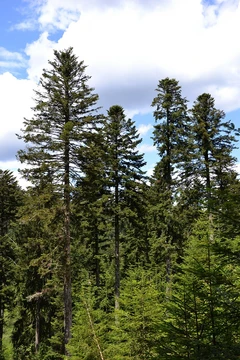
Abies grandis
A tall fir native to northwestern North America, used for timber and Christmas trees.

Abies grandis, known as grand fir, giant fir, lowland white fir, great silver fir, western white fir, Vancouver fir, or Oregon fir, is a large evergreen conifer native to northwestern North America. It is a major constituent of the Grand Fir/Douglas Fir Ecoregion of the Cascade Range. While often cited as one of the tallest firs, the tallest reliably measured Abies species is typically Abies procera. grandis (coast grand fir) and Abies grandis var. idahoensis (interior grand fir), though the interior variety is not universally accepted.
Lore & Background
The tree typically grows to 30–60 m tall, with a trunk diameter up to 1.5 m (2 m being exceptional). Its bark is reddish to gray, furrowed, and divided into slender plates. The leaves are needle-like, glossy dark green above with two green-white bands of stomata below, and arranged in two flat ranks on each side of the shoot. Cones are green to reddish, 6–12 cm long, with winged seeds released when cones disintegrate about six months after pollination.
Reader's Guide
Grand fir is significant as a major component of the Grand Fir/Douglas Fir Ecoregion and as a timber species marketed as hem fir. Its lumber is a softwood used for framing, flooring, and paper-making, valued for resistance to splitting and splintering. The tree has been used by Native Americans for medicinal purposes, including treating tuberculosis, skin ailments, colds, and fever, and its bark was used to cover lodges and make canoes. In the United States, it is popular as a Christmas tree and for decorations due to its citrus-like scent. Due to wildfire suppression, grand fir has proliferated in areas previously dominated by fire-resistant species, but its thin bark makes it susceptible to fire and rot. The species intergrades with white fir in central Oregon, and specimens have lived up to nearly 300 years historically, though 100 years is more typical under modern stressed conditions.
Did You Know?
- Grand fir is one of the tallest firs, but the tallest reliably measured Abies species is typically Abies procera; exceptional grand fir specimens can still reach impressive heights.
- The bark was historically believed to have medicinal properties, and Native Americans used it to treat skin ailments.
- Grand fir lumber is often marketed as 'hem fir,' an umbrella term that includes several other fir and hemlock species.
Physical Form and the Two Varieties
Abies grandis is a large evergreen conifer typically reaching 40 to 70 metres, with exceptional specimens reportedly touching 100 metres. Its trunk can grow to roughly two metres in diameter, and the bark—about five centimetres thick—appears reddish to gray outside with a purple hue within, breaking into slender furrowed plates. The needle-like leaves are flattened and glossy dark green above, bearing two pale bands of stomata below. Although the leaves attach in a spiral pattern, each twists at its base so the foliage lies in two nearly flat ranks along the shoot. The species divides into two varieties: the coast grand fir, a fast-growing giant west of the Cascades from Vancouver Island to Sonoma County, and the interior grand fir, a smaller, slower-growing form on the east slope reaching into the Rockies. The coastal type tolerates winter lows around minus 25 to 30 degrees Celsius and can exceed 1.5 metres of growth per year when young, while the interior type endures temperatures near minus 40 degrees but rarely surpasses 0.6 metres annually.
Range, Habitat, and Ecological Pressures
Grand fir occupies temperate rainforests along the Pacific coast from southwest British Columbia down to Northern California, while its interior counterpart thrives in montane conifer forests of eastern Washington, the Idaho Panhandle, and far western Montana. Grand fir is more shade tolerant than Douglas-fir but less so than those two species. A significant ecological shift has occurred due to wildfire suppression: grand fir has expanded into areas once dominated by fire-resistant inland Douglas fir, ponderosa pine, and western larch. This expansion has created dense fuel ladders that enable crown fires. The species' bark is thinner than white fir's, leaving it more vulnerable to fire and rot. Because it cannot produce pitch to seal wounds from logging or small fires, rot fungi exploit any breach. East of the Cascades, Indian paint fungus marks trunks with rotten cores, and waterlogged specimens can crack apart in freezing weather. Historically, grand fir could live nearly 300 years, though modern stressed conditions have reduced typical longevity to around 100.
Discovery, Taxonomy, and Relationship to White Fir
Since then, the tree has accumulated a remarkable array of common names—grand fir, giant fir, lowland white fir, great silver fir, western white fir, Vancouver fir, and Oregon fir—reflecting its wide geographic presence and the various communities that encountered it. Taxonomically, grand fir sits very close to white fir (Abies concolor), and the two intergrade in central Oregon. Firs from the Blue Mountains and the Oregon East Cascade Slope display genetic and morphological traits intermediate between the species, often catalogued as a hybrid. Farther south, near the California state line, these intergrades blend further into Abies concolor lowiana. The two varieties of grand fir themselves are considered by some to warrant subspecies rank, though that elevation has not yet been formally published. This web of close relationships makes grand fir a fascinating case study in how geographic isolation and hybridization shape conifer diversity across the Pacific Northwest.
Cultural Uses and Economic Value
Long before European contact, Indigenous peoples across the Plateau and coastal regions incorporated grand fir into daily life and medicine. The Nlaka'pamux covered lodges with its bark, fashioned canoes from the material, and used branches as bedding. Several Plateau tribes applied the inner bark to treat colds and fever, while other groups powdered the bark or pitch to address tuberculosis and skin ailments. In the Okanagan-Colville tradition, the species served as a strengthening agent. In modern North America, grand fir holds a prominent place as a Christmas tree, prized for its full, symmetrical form. Its softwood lumber is harvested commercially as hem fir and finds application in paper-making, construction framing, and flooring, where its resistance to splitting and splintering makes it a preferred choice. The boughs also serve a practical purpose as a natural rain shelter. The tree's bark was historically believed to possess medicinal properties, a tradition that echoes the earlier Indigenous uses. As a major constituent of the Grand Fir/Douglas Fir Ecoregion of the Cascade Range, it underpins both ecological structure and the timber economies of the Pacific Northwest.
Frequently Asked Questions
What is Abies grandis?
Abies grandis is a large evergreen conifer native to northwestern North America, commonly called grand fir, giant fir, western white fir, or Oregon fir depending on the region.
What role does Abies grandis play in its ecosystem and human use?
It is a major constituent of the Grand Fir/Douglas Fir Ecoregion in the Cascade Range and is widely harvested for both timber and Christmas trees.
How many varieties of Abies grandis are recognized?
The species is divided into two varieties, with the coastal form designated as Abies grandis var. grandis and the other representing a distinct inland population.
Is Abies grandis the tallest fir in the world?
Although it is frequently cited as one of the tallest firs, the title of tallest reliably measured Abies species generally belongs to Abies procera rather than Abies grandis.
More in Conifers 1-23
Spotted an error? Know more?
This is a living reference — every entry is fact-audited, and reader corrections feed straight into our audit queue. Suggest an edit · See this site's audit record