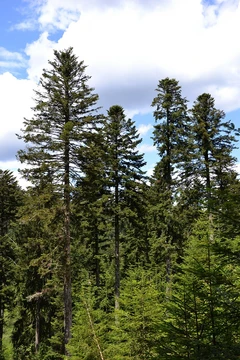
Abies balsamea
A North American fir valued for fragrance, medicine, and Christmas trees.

Abies balsamea, commonly known as balsam fir, is a North American evergreen tree native to most of eastern and central Canada and the northeastern United States. It is a small to medium-size tree, typically 14–20 meters tall, with a narrow conic crown and dense, dark-green needles. The tree is notable for its medicinal uses by Native Americans, its role as a popular Christmas tree, and its ecological importance as a host for wildlife and a subject of pest outbreaks.
- height
- 14–20 m (46–66 ft), occasionally 24 m (79 ft)
- tallest_specimen
- 24 m (79 ft)
Lore & Background
Balsam fir has been used for thousands of years by Native Americans for medicinal and therapeutic purposes. The needles are eaten directly or brewed into tea, and the tree contains vitamin C. Its essential oil and compounds have shown efficacy against ticks. The resin, known as Canada balsam, was traditionally used as a cold remedy and as a glue for optical instruments and microscope slides. The wood is milled for lumber and paper, and the oil is sometimes marketed as a rodent repellent, though EPA approval applies only to specific registered products, not to the oil in general.
Reader's Guide
Abies balsamea is significant for its ecological and economic roles. It is a dominant tree in four forest types—swamp, flat, hardwood slope, and mountain top—and provides food and shelter for moose, deer, red squirrels, grouse, and songbirds. It is the preferred host of the eastern spruce budworm, a major pest that can cause severe defoliation and tree death. The tree is also highly cold-hardy and short-lived by conifer standards. Both varieties are popular Christmas trees, especially in the northeastern US, and the species has been used for the US Capitol Christmas Tree six times. Its dwarf cultivar 'Hudson' has received the Royal Horticultural Society's Award of Garden Merit. The balsam fir's medicinal and commercial uses underscore its lasting importance.
Did You Know?
- Needle length in balsam fir varies primarily due to age, light exposure, and branch position, not consistently with height on the tree.
- The variety Abies balsamea var. phanerolepis is generally considered a variety of balsam fir, not a hybrid with Fraser fir.
Physical Form & Botanical Character
Balsam fir is a compact evergreen conifer that typically stands between fourteen and twenty metres tall, though exceptional individuals have been recorded at twenty-seven metres. Its crown is narrow and distinctly conical, densely packed with dark-green foliage that gives the tree a full, sculptural silhouette. On young specimens the bark is smooth and grey, studded with resin blisters that can spray their sticky contents if ruptured; as the tree ages this surface roughens into deep fissures and scaly plates. The needles are flat, measure fifteen to thirty millimetres in length, and carry a slightly notched tip. Above they appear dark green with a small cluster of stomata near the tip, while the underside bears two conspicuous white bands of stomata. Although the needles attach in a spiral around the shoot, their bases are twisted so that they visually align into two roughly horizontal rows. Moving up the canopy, the needles progressively shorten and thicken. The erect seed cones, dark purple when young and ripening to brown, measure forty to eighty millimetres and shatter in September to scatter their winged seeds.
Native Range, Habitat & Extreme Cold Tolerance
Balsam fir is indigenous to a broad swath of eastern and central Canada, stretching from Newfoundland westward to central Alberta, and to the northeastern United States, where it ranges from Minnesota east to Maine and southward through the Appalachian Mountains to West Virginia. The species is highly shade tolerant and thrives in cool climates where the mean annual temperature hovers around four degrees Celsius and root-zone moisture remains consistent. Insufficient moisture and elevated temperatures are the principal factors that limit its distribution. It occupies four characteristic forest settings: waterlogged swamps where it grows slowly and slenderly among sphagnum moss; better-drained dry-swamp flats where it grows tall and fast alongside red spruce; well-drained hardwood slopes shared with yellow birch, sugar maple, and beech; and mountain tops at elevations of roughly seven hundred sixty to fifteen hundred twenty metres, where it may form pure stands or associate with black spruce, white spruce, white birch, and trembling aspen. Remarkably, balsam fir is among the most cold-hardy trees on record, surviving temperatures as low as minus forty-five degrees Celsius, and specimens have shown no damage even when immersed in liquid nitrogen at minus one hundred ninety-six degrees.
Medicinal Heritage & Reproductive Biology
For thousands of years, Indigenous peoples of North America relied on balsam fir for medicinal and therapeutic purposes. The needles can be consumed directly off the tree by both wildlife and humans, while a more concentrated dosage is prepared as a tea. The species contains vitamin C, a compound that has been investigated for its potential effects against bacterial and viral infections. Additionally, the tree's essential oil and certain chemical constituents have demonstrated efficacy in repelling or killing ticks. Reproductively, the male and female structures follow distinct developmental timelines. The male organs mature faster and appear earlier; their microsporangia divide to produce sporogenous tissue, which yields archesporial cells that become microspores, or pollen-mother cells, once rounded and filled with starch. In spring, meiosis generates four haploid microspores that develop into pollen grains, released when the mature strobilus exposes the microsporangia. The larger female megasporangiate bears bracts and megasporophylls, each carrying two ovules in a spiral. Within the nucellus, a mother cell undergoes meiosis to form a megaspore, the first cell of the megagametophyte. Subsequent division produces prothallial tissue containing an ovum, while undifferentiated cells form the endosperm. Fertilization occurs when the pollen tube delivers sperm to the egg.
Wildlife Interactions, Pests & Conservation
Balsam fir plays a central role in its forest ecosystems. Its foliage is a favoured browse for moose and deer, while its seeds sustain American red squirrels, grouse, and pine mice. Crossbills and chickadees feed on the tree, and it offers shelter to moose, snowshoe hares, white-tailed deer, ruffed grouse, and a variety of small mammals and songbirds. Certain lepidopteran caterpillars, including the Io moth, also consume the needles. The species is, however, the preferred primary host of the eastern spruce budworm, a devastating pest across eastern North America. During cyclical population outbreaks, the budworm can cause severe defoliation that significantly suppresses radial growth in affected trees. Two recognized varieties exist: var. balsamea, found across most of the range, and var. phanerolepis—commonly called Canaan fir after the Canaan Valley in West Virginia—restricted to the southeastern portion from southernmost Quebec to West Virginia. Some botanists consider this variety a natural hybrid with Fraser fir. In Connecticut, native populations are listed as endangered.
Frequently Asked Questions
Who is Abies balsamea?
Abies balsamea, commonly called balsam fir, is a small-to-medium evergreen conifer native to eastern and central Canada and the northeastern United States. It typically stands 14–20 meters tall, sporting a narrow conic crown densely packed with dark-green needles.
What are Abies balsamea's powers/role?
The tree is celebrated for its strongly aromatic resin, which Native Americans historically tapped for medicinal and practical uses. It is also one of the most popular species selected as a Christmas tree, prized for its dense branching and pleasant fragrance.
How does Abies balsamea's story end?
As a long-lived conifer it can persist for centuries, occasionally reaching 24 meters before eventually falling to age, disease, or insect pressure. In the wild, outbreaks of pests such as the balsam woolly adelgid can cut individual trees' lifespans dramatically short.
Why is Abies balsamea important?
Ecologically it provides critical nesting habitat, forage, and shelter for birds, small mammals, and other wildlife across its range. It also underpins regional economies through timber, ornamental trade, and its enduring cultural role as a Christmas tree.
Where does Abies balsamea live?
Its native range covers most of eastern and central Canada along with the northeastern United States, favoring cool, moist, often acidic soils. It can be found from near sea level up through subalpine elevations, making it one of the more range-wide firs in North America.
More in Conifers 1-23
Spotted an error? Know more?
This is a living reference — every entry is fact-audited, and reader corrections feed straight into our audit queue. Suggest an edit · See this site's audit record