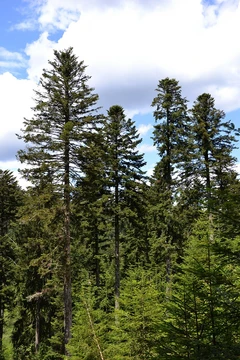
Abies nordmanniana
Evergreen conifer prized as a Christmas tree and notable for its height in the Caucasus.

Abies nordmanniana, known as the Nordmann fir or Caucasian fir, is a large evergreen coniferous tree indigenous to the mountains south and east of the Black Sea, in Turkey, Georgia, and the Russian Caucasus. It is notable for being one of the most important species grown for Christmas trees, favored for its attractive foliage, non-sharp needles, and resistance to dropping needles when dried. The species also holds records as the tallest tree in the Caucasus, Anatolia, and the Russian Federation, though it is not the tallest in Europe—that title belongs to a Eucalyptus regnans in Portugal, and the tallest native European conifers are Abies alba or Picea abies, with historical reports of 78 m and 85 m specimens being unverified.
- known_for
- Christmas tree cultivation, tall conifer in Caucasus and Anatolia
- max_height
- Up to 85 m (historical, unverified)
Lore & Background
The species is named by Christian von Steven after the Finnish zoologist Alexander von Nordmann, who was director of the Odessa Botanical Gardens. Its current distribution is linked to forest refugia that existed during the Ice Age along the eastern and southern Black Sea coast. Despite suitable climate, the species is absent from areas of the Eastern Greater Caucasus, primarily due to climatic and ecological factors rather than simple distance. There are two subspecies: Abies nordmanniana subsp. nordmanniana (Caucasian fir), native to the Caucasus mountains and eastern Pontic Mountains, with shoots often pubescent; and Abies nordmanniana subsp. The Turkish subspecies is sometimes treated as a separate species (Abies bornmuelleriana or Abies equi-trojani) and is assessed as 'Endangered'. Its shoots are usually glabrous. The tree's leaves are needle-like, flattened, 1.8–3.5 cm long, glossy dark green above with two blue-white bands of stomata below.
Reader's Guide
Abies nordmanniana holds significance both ecologically and economically. Ecologically, it is a key component of montane forests in the Caucasus and northern Turkey, surviving in Ice Age refugia and now absent from areas separated by large distances. Its two subspecies illustrate ongoing taxonomic debate, with the Turkish fir considered endangered due to its extremely limited range. Economically, the Nordmann fir is one of the most important Christmas tree species in Europe, valued for its non-sharp needles and needle retention. It is also a popular ornamental tree in parks and large gardens, with the cultivar 'Golden Spreader' receiving the Royal Horticultural Society's Award of Garden Merit. In Europe, the tree has been used for reforestation to mitigate expected forest decline from climate change. Its wood, soft and white, is used for general construction and paper. The species also holds the record for the tallest trees in the Caucasus, Anatolia, the Russian Federation, and Europe, with specimens reaching up to 85 m in the Western Caucasus Reserve.
Did You Know?
- The Nordmann fir is named after Finnish zoologist Alexander von Nordmann, director of the Odessa Botanical Gardens.
- Historical reports of 78 m and 85 m tall specimens in the Western Caucasus Reserve are unverified; the tallest tree in Europe is a Eucalyptus regnans in Portugal, and the tallest native European conifers are Abies alba o
- The Turkish fir subspecies (Abies nordmanniana subsp. equi-trojani) is not endemic to a single location on Kaz Dağı; it occurs on several mountains in northwestern Turkey, including Uludağ and Kaz Dağı, with a range broa
Biogeographic Roots and Ice Age Legacy
The Nordmann fir is a conifer native to the mountain ranges flanking the southern and eastern shores of the Black Sea, spanning Turkey, Georgia, and the Russian Caucasus. What makes its present-day range particularly fascinating is its deep connection to glacial-era survival. Botanists trace the species' current distribution to forest refugia that persisted along the eastern and southern Black Sea coastline during the Ice Age, when much of the surrounding landscape was locked under ice or rendered inhospitable. A striking gap in its range underscores this history: despite currently suitable climate conditions, the tree is entirely absent from the Eastern Greater Caucasus. The result is a distribution pattern that reads less like a simple climate map and more like a fossil record of where life held on when the world was colder.
Physical Grandeur and Morphology
Standing as a large evergreen conifer, the Nordmann fir typically reaches heights of 55 to 61 metres with a trunk diameter that can approach two metres. Yet the true giants push well beyond these norms. Within the Western Caucasus Reserve, individual specimens have been recorded at 78 metres and, remarkably, 85 metres tall—making them the tallest trees not only in the Caucasus and Anatolia but across the entire Russian Federation and the continent of Europe. The foliage is distinctive: flattened, needle-like leaves measuring 1.8 to 3.5 centimetres in length, 2 millimetres wide, and just half a millimetre thick. Their upper surface gleams a deep green, while the underside bears two pale blue-white bands of stomata. Leaf tips are generally blunt, sometimes slightly notched, though younger, vigorously growing shoots may produce pointed tips. At maturity the cone structure breaks apart, scattering its seeds into the air.
Taxonomy and the Two Subspecies
Within the species, botanists recognise two subspecies that intergrade where they meet in northern Turkey near the 36°E longitude line. The Caucasian fir (subsp. nordmanniana) occupies the Caucasus mountains and the eastern Pontic Mountains of northeastern Turkey, and its young shoots are frequently covered in fine hairs. The Turkish fir (subsp. equi-trojani) ranges across northwestern Turkey, including the western Pontic Mountains, Uludağ, and other peaks southeast of the Sea of Marmara. Many taxonomists elevate it to full species status as Abies bornmuelleriana, and Turkish forestry authorities treat it as a distinct species, Abies equi-trojani. Its shoots are typically hairless, a useful distinguishing trait.
Cultivation, Uses, and a Role in Reforestation
Few conifers have achieved the Nordmann fir's cultural prominence in European households. It ranks among the most important species cultivated for Christmas trees, prized for its attractive foliage, its needles that lack the sharp prickle of many relatives, and its remarkable resistance to needle drop once the tree is cut and begins to dry. Beyond the holiday season, the species is a popular ornamental choice for parks and large gardens across the continent. Its cultivar 'Golden Spreader' has earned the Royal Horticultural Society's Award of Garden Merit, a recognition of its lasting decorative value in cultivated landscapes. In a more utilitarian vein, the tree's soft, white wood finds use in general construction and paper production. Perhaps most forward-looking is its role in European reforestation programmes, where it is being planted as a strategy to offset anticipated forest decline driven by climate change. In this way, a tree once confined to Black Sea mountainsides now serves as both a symbol of winter tradition and a practical tool for ecological resilience.
Frequently Asked Questions
What is Abies nordmanniana?
Abies nordmanniana, commonly called the Nordmann fir or Caucasian fir, is a large evergreen conifer native to the mountain ranges south and east of the Black Sea. It spans parts of Turkey, Georgia, and the Russian Caucasus, where it forms a distinctive element of high-altitude forest.
Why is Abies nordmanniana so popular as a Christmas tree?
Growers and holiday shoppers favor it because its needles are soft and non-sharp, its foliage stays lush and attractive, and it resists shedding needles long after being cut. These traits make it one of the top commercial Christmas-tree species worldwide.
How tall can Abies nordmanniana get?
Under ideal conditions it can reach roughly 85 metres, a figure drawn from historical records that remain unverified by modern measurement. It holds the tallest-tree record in the Caucasus, in Anatolia, and across the Russian Federation.
Where does Abies nordmanniana grow in the wild?
Its natural range is confined to montane forests in Turkey, Georgia, and the Russian Caucasus, generally on slopes south and east of the Black Sea. Outside that region it is found almost exclusively in cultivation, especially in Christmas-tree plantations.
Is Abies nordmanniana the tallest tree in Europe?
No. Although it is the tallest conifer in the Caucasus and Anatolia, the overall tallest tree in Europe is a Eucalyptus regnans standing in Portugal. Abies nordmanniana's height record is regional rather than continental.
More in Conifers 1-23
Spotted an error? Know more?
This is a living reference — every entry is fact-audited, and reader corrections feed straight into our audit queue. Suggest an edit · See this site's audit record