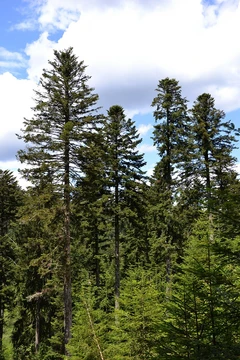
Araucaria araucana
Hardy conifer native to the southern Andes, now endangered.

Araucaria araucana goes by many names: pewen, monkey-puzzle tree, pehuen, piñonero, or Chile pine. This conifer, part of the Araucariaceae family, can reach 30–40 meters tall with a trunk up to 1.5 meters wide. It grows naturally in central and southern Chile and western Argentina, and it’s the toughest member of its genus. Chile and the Argentine province of Neuquén both claim it as their national tree.
Its leaves are thick, tough, and scale-like, triangular in shape, 3–4 cm long and 1–3 cm wide at the base, with sharp edges and tips. They stay on the tree for up to 24 years, covering nearly every branch except the oldest ones. The tree is usually dioecious, meaning male and female cones grow on separate trees, though occasionally one tree bears both. Male cones start out oblong and cucumber-shaped at 4 cm long, then expand to 8–12 cm long and 5–6 cm wide when releasing pollen, which is carried by the wind. Female cones are globose, 12–20 cm across, and mature about 18 months after pollination, each holding roughly 200 seeds. When ripe, the cones break apart to release nut-like seeds 3–4 cm long. The bark can be up to 15 cm thick, possibly an adaptation to wildfires.
Its closest living relative is Araucaria angustifolia from Brazil and northeastern Argentina, which has narrower leaves and shorter spines on its seed cones. Other members of the genus live on Pacific Islands and in Australia, including A. cunninghamii, A. heterophylla, and A. bidwillii.
In the wild, Araucaria araucana grows on the lower slopes of the south-central Andes in Chile and Argentina, between about 1,000 and 1,700 meters elevation. In the Chilean Coast Range, it reaches as far south as Villa Las Araucarias at 640 meters. Young trees have a broadly pyramidal shape that becomes the classic umbrella form as they age. It prefers well-drained, slightly acidic volcanic soil but tolerates almost any soil that drains well. Seedlings struggle to compete unless they sprout in a canopy gap or an open, exposed spot. It rarely grows alongside Chusquea culeou, Nothofagus dombeyi, or Nothofagus pumilio, as those species tend to outcompete it.
This tree is a masting species, and rodents are key consumers and dispersers of its seeds. The long-haired grass mouse Abrothrix longipilis is the most important disperser, burying whole seeds in spots where they can germinate. The austral parakeet also helps spread seeds. Adult trees resist large disturbances like volcanic eruptions, and after such events, parakeets carry seeds far from the affected area.
Logging was a major threat until it was banned in 1990. Large fires burned thousands of acres of Araucaria forest in 2001–2002, including areas in national parks, destroying trees over 1,300 years old. Overgrazing, invasive trees, and heavy human harvesting of piñones (the seeds) also prevent new trees from growing. A Global Trees Campaign project planted 2,000 trees and found a 90 percent survival rate after ten years. Non-native seed-eating mammals may also restrict reproduction, though one study found native species caused more seed destruction than non-natives. That result might be because the invasive species were introduced recently and are still few. Another study showed that cattle ranching by small landowners and larger timber companies severely limits seedling regeneration.
Araucaria araucana is a popular garden tree, valued for its thick, reptilian-looking branches and symmetrical shape. It thrives in temperate oceanic climates with plenty of rain and can tolerate temperatures down to about −20 °C. It is by far the hardiest species in its genus. It grows well in western and central Europe, north to the Faroe Islands and Smøla in Norway; on North America’s West Coast up to Baranof Island in Alaska and on the East Coast as far north as Long Island; south of its native range in southern Chile; and in New Zealand and southeastern Australia. It handles coastal salt spray but not air pollution. Its seeds, called ngulliw in Mapudungun and piñones in Spanish, are edible and similar to large pine nuts, harvested by indigenous peoples in Argentina and Chile. The tree could become a food crop in cool oceanic climates like western Scotland, where other nuts don’t grow well. A group of six female trees with one male for pollination could yield several thousand seeds per year, and since the cones drop, harvesting is easy. However, the tree does not produce seeds until it is older.
- trunk_diameter
- 1–1.5 m (3.3–4.9 ft)
- leaf_lifespan
- up to 24 years
- seed_maturation
- about 18 months after pollination
- elevation_range
- approximately 1,000–1,700 m (3,300–5,600 ft)
- temperature_tolerance
- down to about −20 °C (−4 °F)
Lore & Background
Araucaria araucana is a tree that grows to a height of 30–40 m with a trunk diameter of 1–1.5 m. Its leaves are thick, tough, and scale-like, remaining attached and live for up to 24 years. It is usually dioecious, with male and female cones on separate trees, though occasional individuals bear cones of both sexes. The male cones are oblong and cucumber-shaped, expanding to 8–12 cm long at pollen release, while female cones are globose, 12–20 cm in diameter, and hold about 200 seeds. The thick bark, up to 15 cm thick, may be an adaptation to wildfire. The tree's native habitat is the lower slopes of the Chilean and Argentine south-central Andes, between approximately 1,000 m and 1,700 m elevation. It prefers well-drained, slightly acidic, volcanic soil. Seedlings are often not competitive enough to survive unless grown in a canopy gap or exposed area. It is almost never found together with Chusquea culeou, Nothofagus dombeyi, or Nothofagus pumilio because they typically outcompete it. Araucaria araucana is a masting species. The long-haired grass mouse Abrothrix longipilis is the most important animal responsible for dispersing its seeds, burying them whole in favorable locations. Another important seed dispersal agent is the austral parakeet. Adult trees are highly resistant to large ecological disturbances caused by volcanic activity.
Reader's Guide
Araucaria araucana holds significant ecological and cultural importance. It is the national tree of Chile and of the Argentine province of Neuquén, and its seeds, called piñones, are harvested by indigenous peoples in Argentina and Chile. The tree is sacred to some indigenous Mapuche, and the Pehuenches people owe their name to their diet based on its seeds. Non-native seed-eating mammals also threaten its reproduction, though the extent of their impact remains uncertain. The species is protected under Appendix I of CITES, regulating international trade. Despite its rarity, it is a popular garden tree in temperate oceanic climates, tolerating temperatures down to about −20 °C. Its seeds are edible and similar to large pine nuts, with potential as a food crop in cool oceanic summers, though trees do not yield seeds until around 30–40 years old. The tree's wood, once valued for railway sleepers and veneers, is now rarely used due to its vulnerable status.
Did You Know?
- The leaves of Araucaria araucana remain attached and live for up to 24 years.
- The long-haired grass mouse Abrothrix longipilis is the most important animal responsible for dispersing its seeds.
- Its thick bark, up to 15 cm thick, may be an adaptation to wildfire.
Architectural Form and Reproductive Biology
The monkey-puzzle tree commands attention through its dramatic silhouette. Young specimens grow in a tight, conical shape, but as decades pass the crown spreads outward into the iconic umbrella profile that has made this species instantly recognizable. Reaching thirty to forty meters in height with trunks a meter to a meter and a half across, it dwarfs most conifers in its native Andean range. Its foliage is unlike any other: thick, leathery, triangular scales with razor-sharp tips that cling to the branches for as long as twenty-four years, giving the canopy a dense, almost reptilian texture. Reproduction follows a largely dioecious pattern, with pollen-bearing and seed-bearing cones typically on separate individuals. The oblong, cucumber-shaped male cones release their pollen on the wind, while the large globose female cones—up to twenty centimeters across and holding roughly two hundred seeds—take about eighteen months to ripen before disintegrating and dropping their nut-like kernels. The species' bark can thicken to fifteen centimeters, a trait researchers suspect evolved as a buffer against the wildfires that periodically sweep through its habitat.
Ecological Niche and Seed Dispersal
Araucaria araucana occupies a narrow band on the lower slopes of the south-central Andes, typically between one thousand and one thousand seven hundred meters of elevation, though in the Chilean Coast Range it dips as low as six hundred and forty meters near Villa Las Araucarias. It thrives in well-drained, slightly acidic volcanic soils and is the hardiest member of its genus. Its seedlings, however, are poor competitors; they rarely establish unless they find a canopy gap or an exposed, isolated patch of ground, and they are almost never seen alongside Chusquea culeou or the two Nothofagus species that tend to outcompete them. The tree is a masting species, producing crops of seeds in synchronized bursts. The long-haired grass mouse, Abrothrix longipilis, is the principal disperser, burying whole seeds in microsites favorable for germination. The austral parakeet plays a crucial secondary role, especially after volcanic eruptions, when it carries seeds far beyond the devastated zone, helping the remarkably disturbance-resistant adult trees repopulate cleared territory.
Conservation Crisis and Recovery Efforts
Yet the threats never fully receded. Overgrazing by cattle—driven by both small landowners and large timber operations—suppresses seedling regeneration, while invasive tree species and non-native seed-eating mammals further erode the tree's ability to reproduce. Extensive human collection of piñones also starves the forest of its next generation. On the positive side, a Global Trees Campaign initiative that planted two thousand individuals recorded a ninety percent survival rate over a decade, offering a tangible model for restoration. Research into the relative impact of native versus invasive seed predators remains ongoing, with some studies suggesting that recently introduced non-natives may not yet have reached populations large enough to dominate the threat landscape.
Cultural Heritage and Horticultural Legacy
The pewen holds a place of deep national pride: it is the official tree of Chile and of the Argentine province of Neuquén. Indigenous Mapuche and other communities have long gathered its seeds—called ngulliw in Mapudungun and piñones in Spanish—as an edible nut comparable in character to a large pine nut. Beyond its native range, the species has become a beloved ornamental in gardens across temperate zones, prized for its thick, geometrically symmetrical branches that give it an almost prehistoric, reptilian character. It tolerates temperatures as low as minus twenty degrees Celsius, making it the hardiest Araucaria, and it thrives from the Faroe Islands and western Norway in Europe to Baranof Island in Alaska and Long Island on the American East Coast, as well as New Zealand and southeastern Australia. It shrugs off coastal salt spray but is sensitive to urban air pollution. Though a tree does not begin producing seeds until it is thirty to forty years old, a small orchard of six females and one male can yield several thousand nuts annually, and the cones drop naturally, simplifying harvest. Individuals can live well past a thousand years, making each mature specimen a living monument.
Frequently Asked Questions
Who is Araucaria araucana?
Araucaria araucana is a hardy conifer in the family Araucariaceae, widely known by names like monkey-puzzle tree, pewen, or Chile pine. It is the toughest species within the entire Araucaria genus and grows natively in the high Andes of central-southern Chile and western Argentina.
What are Araucaria araucana's powers/role?
This tree tolerates temperatures as low as −20 °C and retains its needles for up to 24 years, giving it exceptional resilience among conifers. It can reach 30–40 m in height with a trunk diameter of 1–1.5 m, and its seeds require roughly 18 months after pollination to fully mature.
Why is Araucaria araucana important?
It is the official national tree of Chile and the designated tree of Argentina's Neuquén province, making it a powerful cultural symbol for both regions. Ecologically, it anchors the high-elevation mountain communities where it grows, providing habitat and structure at altitudes between roughly 1,000 and 1,700 m.
Where does Araucaria araucana live?
Its natural range stretches across the central and southern Andes, spanning parts of Chile and western Argentina. The species typically occupies mountain slopes between approximately 1,000 and 1,700 m in elevation, thriving in the cool, windy conditions of that band.
More in Conifers 1-23
Spotted an error? Know more?
This is a living reference — every entry is fact-audited, and reader corrections feed straight into our audit queue. Suggest an edit · See this site's audit record