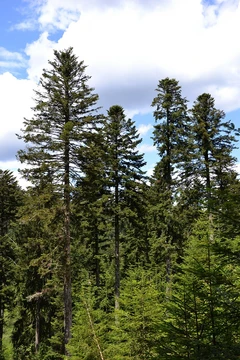
Callitropsis nootkatensis
Long-lived conifer of northwestern North America, valued for durable wood.

Callitropsis nootkatensis is a conifer from the cypress family that grows along the northwestern coast of North America. It goes by several common names, such as Nootka cypress, yellow cedar, Alaska cedar, and Alaska yellow cedar. The name *nootkatensis* comes from Nootka Sound on Vancouver Island, which itself was named after the Nuu-chah-nulth First Nation by early European explorers.
This evergreen tree can reach 40 meters tall, occasionally up to 60 meters, with trunks up to 3.4 to 4 meters in diameter. Its bark starts out thin, smooth, and purplish when young, then becomes flaky and gray with age. The branches often droop, and the foliage grows in flat sprays with dark green scale-like leaves 3 to 5 millimeters long. The cones take two years to mature, have 4 scales (sometimes 6), and look like those of *Cupressus lusitanica* but are smaller—typically 8 to 14 millimeters across. Each scale has a pointed triangular bract about 1.5 to 2 millimeters long, similar to other *Cupressus* species. The winged seeds are tiny and don't travel far, and only a small percentage are viable.
The oldest known Nootka cypress trees are in British Columbia’s Caren Range, where one specimen was dated at 1,834 years old; some may be over 3,000 years old. This species is also one parent of the hybrid Leyland cypress, the other being Monterey cypress, which was once placed in the same genus but is now considered part of the North American *Hesperocyparis* group—genetically closer to *C. nootkatensis* than to Old World *Cupressus*.
Taxonomically, the tree has been shuffled around. First described as *Cupressus nootkatensis* in 1824 from a specimen collected at Nootka Sound, it was moved to *Chamaecyparis* in 1841 because its flat foliage sprays resemble that genus. But its cones—maturing in two years rather than one—are more like *Cupressus*. Genetic work by Gadek and others supported a return to *Cupressus*. In 2002, Farjon and colleagues placed it in a new genus, *Xanthocyparis*, along with the newly discovered Vietnamese golden cypress. However, Little et al. later pointed out that an 1864 combination in *Callitropsis* existed and was overlooked, so they synonymized *Xanthocyparis* with *Callitropsis*. The name *Xanthocyparis* was proposed for conservation, and the 2011 International Botanical Congress upheld that. In 2010, Mao et al. used molecular analysis to put it back in *Cupressus*, but the Gymnosperm Database suggested it could stand alone as *Callitropsis nootkatensis*. Finally, a 2021 study by Stull et al. confirmed it belongs in *Callitropsis*, placing it as sister to *Hesperocyparis*, with both sister to *Xanthocyparis* (which contains only the Vietnamese golden cypress), and that whole clade sister to a group containing *Juniperus* and *Cupressus* proper.
The tree grows in moist areas of coastal mountains from Alaska’s Kenai Peninsula to northern California’s Klamath Mountains, often at higher elevations than western redcedar. It can appear as krummholz and even on rocky sites near the California-Oregon border. Elevations range from 600 to 750 meters in Southeast Alaska and 750 to 2,000 meters from coastal British Columbia into Oregon. Isolated groves near Nelson, British Columbia, and John Day, Oregon, may be remnants from the last ice age.
Nootka cypress thrives where annual precipitation exceeds 150 centimeters, especially with deep snow, and temperatures rarely drop below −18 °C. Its flexible branches resist breaking under snow. It is shade tolerant but less so than mountain hemlock and Pacific silver fir, and it grows slowly. Natural antifungal chemicals help it live long, and insects rarely bother it, though heart rot can be a problem. In Alaska, where it’s mostly called yellow cedar, large-scale die-offs have been studied. Researchers found that the tree relies on heavy coastal snowpacks to insulate its shallow roots from harsh Arctic winters, and climate change is disrupting that protection.
- Scientific name
- Callitropsis nootkatensis
- Family
- Cupressaceae
- Native range
- Coastal northwestern North America, from Kenai Peninsula (Alaska) to Klamath Mountains (California)
- Maximum diameter
- 3.4 to 4 m (11 to 13 ft)
- Conservation status
- Under review by U.S. Fish & Wildlife Service for threatened or endangered designation
Lore & Background
Its taxonomy has been disputed: it has been placed in Chamaecyparis, returned to Cupressus, moved to Xanthocyparis, and finally to Callitropsis based on genetic evidence. The tree grows in moist coastal mountains, often at higher elevations than western redcedar, and can form krummholz at treeline. It is shade tolerant but less so than associated mountain hemlock and Pacific silver fir. Its shallow roots depend on heavy snowpack for insulation from Arctic winters; climate change has caused die-offs across 7% of its range due to reduced snowpack and freeze damage. Indigenous peoples of the Pacific Northwest Coast used the stronger inner bark for canoe paddles, baskets, and thread for clothing and blankets. The wood is highly durable, resistant to weather and insects, and has been exported to China. It is used for flooring, interior finish, shipbuilding, and as firewood that can be used up to 100 years after the tree's death.
Reader's Guide
Callitropsis nootkatensis holds significance as a long-lived conifer with a complex taxonomic history that reflects ongoing debates in plant systematics. Its wood is prized for its strength, durability, and resistance to decay, making it valuable for construction, boatbuilding, and finished carpentry. The species is also ecologically important in Pacific Northwest forests, where it occupies high-elevation habitats and provides habitat and resources for wildlife. Its vulnerability to climate change, evidenced by large-scale die-offs in Alaska linked to reduced snowpack, highlights the broader impacts of warming temperatures on montane ecosystems. The U.S. Fish & Wildlife Service's review for potential threatened or endangered status underscores conservation concerns. Additionally, the tree's role as one parent of the hybrid Leyland cypress demonstrates its horticultural importance. The species' cultural use by indigenous peoples and its historical export to China further illustrate its multifaceted legacy.
Did You Know?
- The tree is one parent of the hybrid Leyland cypress; the other parent is Monterey cypress.
- Its wood can be used for firewood up to 100 years after the tree's death.
- The specific epithet 'nootkatensis' derives from Nootka Sound, named for the Nuu-chah-nulth First Nation.
A Century of Taxonomic Debate
The taxonomic journey of this species reads like a decades-long argument among botanists. Yet its cones—maturing over two years and bearing pointed triangular bracts—never quite matched Chamaecyparis morphology. In 2002, Farjon and colleagues carved out a new genus, Xanthocyparis, pairing it with the strikingly similar Vietnamese golden cypress.
Form, Scale, and Extraordinary Age
Standing as an evergreen conifer, this tree typically reaches heights around forty meters, though exceptional individuals have been recorded at sixty meters with trunk diameters approaching four meters. Young bark presents a smooth, purplish surface that eventually weathers into a flaky gray texture. The branches often droop in pendulous arcs, carrying dark green scale-leaves arranged in flat sprays, each leaf just three to five millimeters long. Its cones are small—eight to fourteen millimeters across—with four (sometimes six) scales, each tipped by a pointed triangular bract roughly one and a half to two millimeters in length. The winged seeds are tiny, limiting dispersal to short distances, and only a small fraction proves viable. The tree also serves as one parent of the popular Leyland cypress hybrid, crossed with Monterey cypress.
Range, Elevation, and Glacial Relics
This species thrives in the moist, coastal mountain forests of the Pacific Northwest, stretching from the Kenai Peninsula in Alaska southward through the Cascades to the Klamath Mountains in northernmost California. It occupies elevations that often exceed those of western redcedar, sometimes appearing in a stunted krummholz form or clinging to very rocky terrain near the California-Oregon border. Two particularly intriguing populations exist in isolated groves near Nelson, British Columbia, and John Day, Oregon. These small stands may represent surviving descendants of local populations that persisted through the Last Glacial Period, making them potential living relics of a much older forest community that once covered broader areas of the continent.
Snowpack Dependency and a Warming Threat
Its flexible branches shed snow without breaking, and internal anti-fungal compounds contribute to its remarkable lifespan. It grows slowly and tolerates shade, though less so than neighboring mountain hemlock or Pacific silver fir. Insect damage is uncommon, though heart rot can affect older specimens. A far more pressing threat has emerged in Alaska, where the tree is commonly called yellow cedar. Extensive research into large-scale die-offs has revealed that the species has long relied on heavy coastal snowpacks to insulate its shallow root systems from Arctic winter cold. Warming temperatures and thinner, less persistent snow cover have removed this natural protection, exposing roots to lethal freeze damage. This mortality has been documented across more than seven percent of the species' range, spanning roughly ten degrees of latitude from southeastern Alaska to southern British Columbia, and substantial additional losses are anticipated as conditions continue to shift.
Frequently Asked Questions
Who is Callitropsis nootkatensis?
Callitropsis nootkatensis is a coniferous tree in the cypress family (Cupressaceae) native to the coastal stretch of northwestern North America. It goes by many common names—Nootka cypress, yellow cedar, Alaska cypress—reflecting its broad cultural footprint. It was formerly classified under the genus Cupressus before being reclassified into Callitropsis.
Where does Callitropsis nootkatensis grow?
Its native range stretches along the Pacific coast from the Kenai Peninsula in Alaska southward to the Klamath Mountains in California. It favors the cooler, wetter maritime climate of the Pacific Northwest coastal belt.
Why is Callitropsis nootkatensis important to people?
Indigenous peoples of the Pacific Northwest Coast have long relied on its wood for crafting tools, utensils, and clothing because of its workability and natural resistance to rot. Its durable, aromatic timber continues to be prized for construction and carving well into the modern era.
More in Conifers 1-23
Spotted an error? Know more?
This is a living reference — every entry is fact-audited, and reader corrections feed straight into our audit queue. Suggest an edit · See this site's audit record