Araucariaceae
Ancient conifer family with large cones and Southern Hemisphere distribution.

Here is the rewritten encyclopedia entry:
The Araucariaceae family of conifers includes three living groups: *Araucaria*, *Agathis*, and *Wollemia*. Today, these trees mostly grow in the Southern Hemisphere, though a few *Agathis* species reach the Northern Hemisphere in Malesia. During the Jurassic and Cretaceous periods, however, the family was common across the Northern Hemisphere as well.
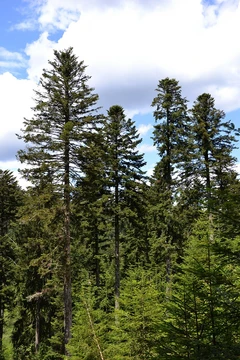
These trees are often enormous, frequently exceeding 60 meters in height. They have straight, column-like trunks with a large central pith and resinous bark. Their branches grow in distinct, horizontal tiers, usually in whorls of three to seven, or in widely spaced pairs. The leaves vary: some are small, curved, and needle-like, while others are large, flat, and broadly oval. They are arranged in a spiral, last for several years, and typically have parallel veins.
Like all conifers, Araucariaceae produce cones. A single tree may bear both male and female cones, or more often, trees are either male or female. Male cones are among the largest of any conifer. They are cylindrical, hang downward like catkins, and grow singly at branch tips or in leaf axils. Each contains many sporophylls arranged in whorls or spirals, with four to twenty elongated pollen sacs attached to the underside. The pollen grains are round and lack air sacs. Female cones are also very large, round or egg-shaped, and sit upright on short, thick stalks at branch tips. Their bracts and scales may be fused or separate for half their length. Each scale usually holds just one seed—unlike true pines, which have two. These seeds are among the largest of any conifer and are often winged for wind dispersal. When mature, the entire female cone falls from the tree. Because of their size, falling cones can be dangerous. For example, the cones of the bunya bunya (*Araucaria bidwillii*) can weigh up to 10 kilograms and drop from 23 meters high.
The family is placed in the order Pinales, class Pinopsida, division Pinophyta (which includes all living conifers). Some recent classifications treat Araucariaceae as its own order, Araucariales. There are three living genera and about 41 species. Molecular evidence suggests that Araucariaceae and Podocarpaceae split from each other in the late Permian.
Today, most species are found in the Southern Hemisphere. New Caledonia has the greatest diversity, with 18 species. Others occur in Australia, Argentina, New Zealand, Chile, southern Brazil, and Malesia. In Malesia, *Agathis* extends just into the Northern Hemisphere, reaching 18°N in the Philippines.
Several species are popular ornamental trees in subtropical gardens, and some provide high-quality timber. Their seeds are edible, similar to pine nuts, and some yield resin and amber. In their native forests, they are often the dominant and largest trees. The tallest is *Araucaria hunsteinii* in New Guinea, reported at 89 meters; several others reach 50–65 meters. The Norfolk Island pine (*Araucaria heterophylla*) is a common landscaping and houseplant. In Turkey’s Erzurum Province, artisans have long used fossilized Araucariaceae wood—known as Oltustone or “Black Amber”—to make jewelry and decorative items. Though classified as a stone, it is actually fossilized trunk pieces. It is dull black but gains a shiny black sheen when polished.
Fossil evidence of Araucariaceae includes the form genera *Araucarites*, *Agathoxylon*, *Araucarioxylon* (wood), *Brachyphyllum* (leaves), *Araucariacites* and *Dilwynites* (pollen), and *Protodammara* (cones). The oldest definite fossils date to the Early Jurassic, with possible earlier records from the Late Triassic. By the Middle Jurassic, early *Araucaria* species were widespread in both hemispheres—for example, *Araucaria mirabilis* from Argentina and *Araucaria sphaerocarpa* from England. The *Wollemia*-*Agathis* lineage appears in the Cretaceous, with fossils like *Emwadea microcarpa* from Australia and *Wairarapaia mildenhallii* from New Zealand. The oldest confidently assigned *Agathis* fossils are *Agathis immortalis* from Patagonia, dating to the Paleocene, roughly 64.67–63.49 million years ago.
- extant_genera
- 3 (Araucaria, Agathis, Wollemia)
- extant_species
- about 41
- greatest_diversity
- New Caledonia (18 species)
- oldest_definitive_fossils
- Early Jurassic
- key_characteristic
- Among the largest cones and seeds among conifers
Lore & Background
Araucariaceae trees are typically extremely tall evergreens, reaching heights of 60 m or more, with large stem diameters. Their trunks are columnar with resinous cortices, and branching is usually horizontal and tiered, arising in whorls of three to seven branches or alternating in widely separated pairs. Leaves can be small, needle-like, and curved, or large, broadly ovate, and flattened, spirally arranged with parallel venation.
Reader's Guide
Araucariaceae holds significance as a relict conifer family that was widespread across both hemispheres during the Jurassic and Cretaceous periods but is now largely restricted to the Southern Hemisphere. Its three living genera—Araucaria, Agathis, and Wollemia—represent a lineage that diverged from Podocarpaceae during the late Permian, according to molecular evidence. The family includes some of the tallest and largest conifers, such as Araucaria hunsteinii reaching 89 m, and produces high-quality timber, edible seeds, resin, and amber. Several species are popular ornamentals in subtropical regions. The fossil record includes forms such as Araucarites, Agathoxylon, and Brachyphyllum, with the oldest definitive records from the Early Jurassic. Notably, fossilized wood of Araucariaceae from Turkey, known as Oltustone or 'Black Amber,' has been used for centuries to manufacture jewelry and decorative items. The family's restricted modern distribution and rich fossil history make it valuable for paleoenvironmental reconstruction.
Did You Know?
- The cones of Araucaria bidwillii weigh up to 10 kg (22 lb), about the size and weight of a large pineapple, and can drop from heights of 23 m (75 ft).
- Fossilized wood of Araucariaceae from Turkey, called Oltustone or 'Black Amber,' has been used for centuries to manufacture jewelry and decorative items.
- The oldest definitive fossils of Araucariaceae are from the Early Jurassic, though potential earlier Late Triassic records exist.
Colossal Stature and Architectural Form
Members of Araucariaceae are among the most physically imposing trees on Earth, routinely exceeding sixty metres in height and developing trunks of extraordinary girth. In New Guinea, Araucaria hunsteinii has been reported at a staggering 89 metres, while several other species in the family regularly reach the 50-to-65-metre range. Structurally, these trees present columnar trunks with notably large central piths and resin-rich outer bark. Their crowns spread in horizontal, tiered layers, with branches emerging in orderly whorls of three to seven or in widely spaced alternating pairs. Foliage varies dramatically within the family: some species bear small, curved, needle-like leaves, while others carry large, broadly ovate, flattened blades. All leaves are arranged spirally along the stem, remain persistent year-round, and display parallel venation.
A Mesozoic Dynasty and Its Fossil Trail
Molecular phylogenetics places the split between Araucariaceae and its closest living relatives, the Podocarpaceae, in the late Permian, making this one of the oldest lineages among conifers. The fossil record confirms a once-vast global presence: the oldest definitive specimens date to the Early Jurassic, with possible Late Triassic antecedents. By the Middle Jurassic, araucarian wood, leaves, and pollen are documented on both sides of the equator, including Araucaria mirabilis from Argentina and Araucaria sphaerocarpa from England. The Wollemia-Agathis lineage appears in Albian-age deposits of Australia and New Zealand, while the first confidently identified Agathis fossils come from the Paleocene Salamanca Formation of Patagonia, roughly 64 to 63 million years ago. Agathis-like foliage also occurs in slightly older Cretaceous strata from the same Patagonian region. Fossils extend as far as the latest Oligocene or earliest Miocene at the southwestern tip of Africa. A suite of form genera—Araucarites, Agathoxylon, Araucarioxylon, Brachyphyllum, Araucariacites, Dilwynites, and Protodammara—preserves wood, leaves, pollen, and cones from this long history. In Turkey's Erzurum Province, artisans have carved jewelry from fossilized araucarian trunks for centuries, a material locally called Oltustone or "Black Amber."
Cone Biology and Seed Dispersal
Reproduction in Araucariaceae follows the conifer pattern of cone production, but the family's cones are exceptional in scale. Trees may be monoecious, bearing both male and female cones on the same individual, or, more typically, dioecious, with separate male and female plants. Male cones rank among the largest in the entire conifer world; they hang in cylindrical, catkin-like clusters at branch tips or leaf axils and contain numerous sporophylls arranged in whorls or spirals, each carrying four to twenty elongated pollen sacs. The pollen grains themselves are round and lack the wings or air sacs that aid dispersal in many other conifers. Female cones are equally massive, spherical to ovoid, and held erect on short, thickened shoots. Their bracts and scales are either fully fused or joined for half their length, and each scale bears a single seed on its upper surface—a notable contrast to the two-seeded scales of true pines in Pinaceae. The seeds are among the largest produced by any conifer and rely on wind dispersal via wing-like structures. When mature, the entire female cone detaches and drops. The bunya bunya (Araucaria bidwillii) produces cones weighing up to ten kilograms, roughly the size of a large pineapple, which can fall from heights of 23 metres and inflict serious injury on anyone below.
Living Range and Human Relationships
Today the family comprises roughly forty-one species across three genera—Araucaria, Agathis, and Wollemia—distributed predominantly across the Southern Hemisphere. New Caledonia holds by far the richest assemblage with eighteen species, while the remainder populate Australia, Argentina, New Zealand, Chile, southern Brazil, and Malesia. In Malesia, Agathis pushes just past the equator, reaching 18 degrees north in the Philippines, a small remnant of the family's once-Northern-Hemisphere range. Ecologically, araucarians are typically the dominant and tallest trees in their forests. Humans have long valued them: several species serve as prized ornamentals in subtropical gardens, the Norfolk Island pine (A. heterophylla) is a familiar houseplant and landscaping tree, and multiple species yield high-quality timber. Their seeds, resembling pine nuts, are edible in several taxa, and some produce valuable resin and amber. In Turkey, fossilized araucarian wood known as Oltustone—named for the town of Oltu in Erzurum Province—has been worked into jewelry and decorative pieces for centuries. Though classified as a semiprecious stone, wood-anatomy studies confirm it is fossilized trunk material, dull and black until polished to a distinctive sheen.
Frequently Asked Questions
What is Araucariaceae and how many species does it include?
Araucariaceae is a conifer family represented today by three living genera—Araucaria, Agathis, and Wollemia—accounting for roughly 41 extant species. Its members are typically towering evergreen trees with columnar trunks, tiered branching, and conspicuously large cones.
Where do Araucariaceae trees grow in the modern world?
Today the family is concentrated in the Southern Hemisphere, with New Caledonia holding the highest diversity at 18 species. A small number of Agathis species in Malesia are the only holdouts in the Northern Hemisphere, a remnant of a once much broader Jurassic and Cretaceous range.
How ancient is the Araucariaceae lineage?
The oldest definitive fossils of the family trace back to the Early Jurassic, making it one of the most ancient conifer lineages still alive. It once dominated far more of the Northern Hemisphere before its range contracted to the Southern Hemisphere over millions of years.
What sets Araucariaceae apart from other conifer families?
The family produces some of the largest cones and seeds among all conifers, a trait that immediately distinguishes it in the field. Pair that with its massive columnar habit and tiered branch architecture, and you get a group that looks unlike almost anything else in the conifer world.
More in Conifers 1-23
Spotted an error? Know more?
This is a living reference — every entry is fact-audited, and reader corrections feed straight into our audit queue. Suggest an edit · See this site's audit record