Cedrus
Ancient conifer valued for durable, scented wood.

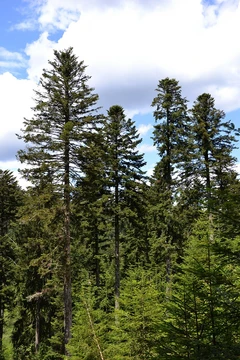
Cedrus, commonly known as cedar, is a genus of coniferous trees in the plant family Pinaceae (subfamily Abietoideae). They are native to the mountains of the western Himalayas and the Mediterranean region at high altitudes, growing tall with a cylindrical trunk and a wide leafy crown. Cedars have been highly valued for millennia for their scented, durable, and decay-resistant wood, used in building temples and palaces since the period of the Epic of Gilgamesh.
- common_name
- Cedar
- family
- Pinaceae (subfamily Abietoideae)
- native_range
- Mountains of the western Himalayas and Mediterranean region
- height
- 30–40 m (rarely to 65 m)
- key_use
- Timber, ornamental, bonsai, cedarwood oil
- notable_feature
- Wood and oil naturally repellent to moths
Lore & Background
The English name derives from Old English ceder, from Latin cedrus, which in turn comes from Greek κέδρος (kédros), meaning cedar or juniper. The word may originally have applied to Greek species of juniper and was later adopted for species now classified in Cedrus because of their aromatic woods. Cedars have a similar cone structure to firs (Abies) and were traditionally thought to be most closely related to them, but genetic evidence indicates they are instead sister to all other lineages in the subfamily Abietoideae.
Reader's Guide
Cedars have been cultivated for their wood for over 4,000 years, with the longest record of any conifer in human use. Recent genetic and environment studies corroborate local oral mythology and Hittite cuneiform texts that two small geographically isolated populations of Lebanon cedar in northern Anatolia were deliberately planted over 3,200 years ago for cedar wood supply to the nearby capital of the Hittite Empire at Hattusa. Cedars are popular ornamental trees in temperate climates and are suitable for training as bonsai. Cedar wood and cedarwood oil are naturally repellent to moths and have an attractive, long-persistent scent. The oldest fossil of Cedrus is Cedrus penzhinaensis from Early Cretaceous (Albian) sediments of Kamchatka, Russia.
Did You Know?
- Cedar cones disintegrate at maturity to release winged seeds, which are wind-dispersed.
- Cedar wood and cedarwood oil are naturally repellent to moths.
- The oldest fossil of Cedrus, Cedrus penzhinaensis, was found in Early Cretaceous (Albian) sediments of Kamchatka, Russia.
- Cedars are monoecious, with separate male and female cones on the same tree.
Taxonomy and Physical Form
The Atlas cedar, scientifically designated as Cedrus atlantica, belongs to the pine family and is indigenous to the mountain ranges of northwestern Africa—specifically the Middle Atlas, High Atlas, and Rif of Morocco, as well as the Tell Atlas in Algeria. Its exact taxonomic standing remains a point of discussion among botanists: while most contemporary references classify it as a fully independent species, a minority of authorities still regard it as merely a subspecies nested within the broader Lebanon cedar (C. libani subsp. atlantica). Physically, a mature Atlas cedar is a commanding evergreen conifer that typically stands between 30 and 35 metres tall, with exceptional individuals occasionally reaching 40 metres. The trunk swells to a diameter of roughly 1.5 to 2 metres. Distinguishing it from its close relatives proves difficult; cone dimensions, for example, average somewhat smaller than those of C. libani but overlap considerably, with lengths ranging from 6 to 12 centimetres across all three taxa. Needle length falls between 10 and 25 millimetres, placing it between C. brevifolia and the nominate C. libani subspecies, yet the ranges intermingle so heavily that visual identification in the field is rarely definitive.
Mountain Ecology and Coexisting Wildlife
These montane forests serve as critical habitat for the endangered Barbary macaque, a primate whose historical range once stretched far more broadly across northern Morocco and Algeria before contracting to its present, diminished strongholds. Morocco currently holds the largest total expanse of Atlas cedar forest on Earth. The species thrives in the humid zones surrounding the Middle-Atlas range, the oriental and Northern High-Atlas, and the Western and Central Rif.
Conservation Pressures and Reforestation Efforts
The Atlas cedar faces persistent threats from timber harvesting, human land use, and wildfires, all of which have driven measurable declines across its range. The Rif mountains, which once hosted one of the largest cedar forests in the region, now contribute only fifteen percent of Morocco's total cedar coverage. In response, massive reforestation campaigns have been launched in the Ifrane Province to rebuild depleted stands. Algeria's situation is equally concerning. Extensive fires and continued human exploitation are cited as the primary drivers of this loss. The combined effect across both countries means that a tree once abundant across the humid mountain belts of northwestern Africa now occupies a fraction of its former domain, making conservation and active replanting urgent priorities for the species' long-term survival.
Ornamental Cultivation and Cultural Footprint
Beyond its native mountains, the Atlas cedar has earned a prominent place in gardens and public landscapes across temperate regions. Its particular value to cultivators lies in a tolerance for dry, hot conditions that exceeds that of most other conifers, making it a practical choice for Mediterranean and continental climates alike. The Glauca group, with its distinctive bluish foliage and more downy shoots, is especially popular, alongside fastigiate, pendulous, and golden-leaf forms. The tree also carries a notable cultural footprint. An Atlas cedar stands on the South Lawn of the White House in Washington, DC, where President Carter commissioned a self-supporting wooden tree house within its branches for his daughter Amy; the President personally designed the structure to avoid damaging the tree. In southern France, large-scale cedar plantations, predominantly of C. atlantica, have been established for commercial timber production, extending the species' economic role well beyond its native range.
Frequently Asked Questions
What exactly is Cedrus?
Cedrus is a genus of coniferous trees belonging to the pine family (Pinaceae), specifically the Abietoideae subfamily. These are the trees we commonly call "cedars," recognizable by their tall cylindrical trunks and broad, leafy crowns.
Where do cedars naturally grow?
They're native to high-altitude mountain zones, specifically the western Himalayas and the Mediterranean region. Cedars thrive at elevation rather than in lowland or coastal settings.
How tall can a cedar tree actually get?
Most mature cedars reach between 30 and 40 meters, though rare exceptional specimens have been recorded at around 65 meters. They grow with a straight, dominant trunk topped by a wide spreading crown.
Why did ancient civilizations prize cedar wood so much?
Its natural decay resistance, durability, and pleasant aromatic scent made it ideal for building temples and palaces. The Epic of Gilgamesh references its use, showing humans have valued it for thousands of years.
Is it true cedar repels moths?
Yes—both the wood itself and the extracted cedarwood oil contain natural compounds that deter moths and other insects. This is why cedar-lined chests and closets have been a go-to for protecting clothing since antiquity.
More in Conifers 1-23
Spotted an error? Know more?
This is a living reference — every entry is fact-audited, and reader corrections feed straight into our audit queue. Suggest an edit · See this site's audit record