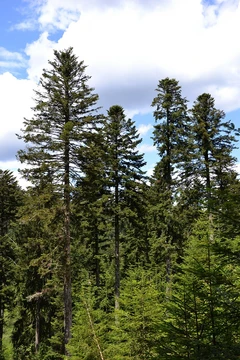
Blue spruce
A conifer with blue needles, native to the Rocky Mountains.

The blue spruce (Picea pungens), also called the Colorado spruce or Colorado blue spruce, is a conifer that grows wild in Arizona, Colorado, Idaho, New Mexico, Utah, and Wyoming. Its needles often have a striking blue-white or blue-green tint due to a waxy coating, which is why people plant it as an ornamental far outside its natural range. In the wild, this tree can reach 50 meters (164 feet) tall, though it’s more commonly around 30 meters (98 feet). In gardens and parks, it usually tops out between 9 and 18 meters (30 to 60 feet) tall, with a spread of 3 to 6 meters (10 to 20 feet). Its bark is scaly and gray-brown with a faint cinnamon-red undertone—less rough than that of an Engelmann spruce. On older trees, the bark becomes deeply furrowed and scaly, and the trunk can be up to 1.5 meters (4.9 feet) in diameter. The root system is dense and compact, with no taproot. Young blue spruces have a conical crown, but as they age the shape becomes more open and irregular. The stout branches grow horizontally in clear whorls, though lower branches droop with age. Young twigs are yellow-brown and never hang downward. The evergreen needles are narrow, sharply pointed, and four-sided, with stomata on all sides. They are stiff, 1.6 to 3 centimeters (3/4 to 1 1/4 inches) long, and attach radially to the shoots but curve upward. New needles show the strongest blue or white color, which fades by summer. In the wild, trees in a stand tend to share similar needle coloration. The leaf buds are golden brown, cone-shaped, 6 to 12 millimeters (1/4 to 1/2 inch) long, and may have blunt or pointed tips. Pollen cones (strobili) develop across the crown but are more common in the upper half. They are mostly yellow with a hint of red and average 1.5 centimeters (1/2 inch) long. Seed cones start growing in May or June and release mature seeds the same autumn. Young seed cones are purple-brown; when fully mature they turn light brown, are longer than wide, circular in cross-section, with thin, papery scales, and may be curved or straight. They measure 5 to 12 centimeters (2 to 4 3/4 inches) long, typically 6 to 11 centimeters (2 1/4 to 4 1/4 inches). Seed cones appear only in the top quarter to tenth of the tree, usually near the ends of side branches. The seeds are dark brown, about 4 millimeters long, with a papery wing that extends almost twice that length. The blue spruce can be confused with Engelmann spruce, European spruce, white spruce, and black spruce, but only Engelmann spruce shares its wild range. Their cone and scale measurements overlap, though blue spruce cones are generally larger (5–12 cm vs. 3–8 cm) and have longer scales (8–10 mm beyond the seed impression vs. 3–8 mm). A key difference: Engelmann twigs are always finely hairy, while blue spruce twigs are usually hairless. The tree’s chemistry is not well studied. Steam-distilled for four hours, ripe seeds yield about 1.17% essential oil, while cones yield 0.38%. The main component (over 40%) is limonene, followed by β-pinene and α-pinene. George Engelmann gave the species its first valid scientific name, *Picea pungens*, in 1879. He had earlier named it *Abies menziesii* (1862) and *Picea menziesii* (1863), but both names were already taken. The specimens used for the description were collected by Charles Christopher Parry on Pikes Peak in 1862. During the late 1800s and early 1900s, many botanists thought *Picea parryana* was the correct name, due to André Michaux’s 1876 description of it as a variety of *Abies menziesii* named *parryana*—which predated Engelmann’s 1879 description. Still, scientists like Ludwig Beissner, Alfred Rehder, and Augustine Henry used *Picea pungens* all along, and by 1925 it was standard in U.S. government publications. The species belongs to the genus *Picea* in the family Pinaceae. It has no accepted varieties, but 35 heterotypic synonyms exist. Genetic analysis suggests the blue spruce’s closest living relative may be *Picea mexicana* (sometimes called *Picea engelmannii* subsp. *mexicana*), a disputed species from northern Mexico. Together they are part of a group of nine North American species that includes Sitka, white, Engelmann, black, red, Chihuahua, and Nuevo León spruces, but not Brewer’s spruce. Despite looking very similar, blue spruce and Engelmann spruce split from a common ancestor between 10 and 20 million years ago. The genus name *Picea* likely comes from the Latin *pix* (pitch), referring to the sticky resin in spruce bark.
- Scientific name
- Picea pungens
- Native range
- Arizona, Colorado, Idaho, New Mexico, Utah, Wyoming
- Typical height in cultivation
- 9–18 m (30–60 ft)
- Family
- Pinaceae
- Notable feature
- Glaucous blue-green needles
Lore & Background
It prefers moist soils along streams or wet meadows and is more tolerant of drought and intense sunlight than associated species. It can withstand extremely low temperatures (-40°C) and is considered a pioneer tree in moist soil in Utah.
Reader's Guide
The blue spruce is significant as a widely planted ornamental tree, valued for its striking blue-green needles that result from surface waxes on the foliage. Its dense, compact root system and tolerance to drought and cold make it adaptable to many environments beyond its native Rocky Mountain range. Ecologically, it occurs in high-elevation conifer forests and riparian zones, often with Douglas-fir or aspen. The species has no accepted varieties but has 35 heterotypic synonyms. Genetic analysis suggests its closest living relative may be Picea mexicana, a disputed species from northern Mexico. The essential oils of its seeds and cones contain over 40% limonene. The blue spruce can be confused with Engelmann spruce, but the twigs of Engelmann are finely hairy while those of blue spruce are usually hairless. Its cones measure 5–12 cm, longer than those of Engelmann spruce, and its seeds are dark brown with a papery wing.
Did You Know?
- The specific epithet 'pungens' means 'sharply pointed', referring to the leaves.
- The blue spruce can withstand temperatures as low as -40°C.
- The main component of its essential oils is limonene, at over 40%.
- The Navajo name for this species is 'c'ó deniní', meaning 'it is sharp'.
Frequently Asked Questions
What is Blue spruce?
Blue spruce is a conifer in the spruce genus, best recognized for its striking silvery-blue foliage. It also goes by the name Colorado spruce and is a member of the pine family, Pinaceae.
Where does Blue spruce grow in the wild?
This tree is native to the Rocky Mountain region of the western United States, with populations found across Arizona, Colorado, Idaho, New Mexico, Utah, and Wyoming.
Why are Blue spruce needles blue?
The needles carry a heavy coating of waxy, glaucous powder that gives them their distinctive blue-green sheen. This natural coating helps the tree conserve moisture in the dry, high-elevation conditions of the Rockies.
More in Conifers 1-23
Spotted an error? Know more?
This is a living reference — every entry is fact-audited, and reader corrections feed straight into our audit queue. Suggest an edit · See this site's audit record