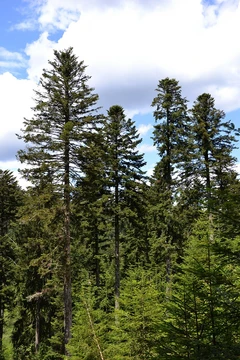
Juniperus communis
Evergreen conifer with the largest range of any woody plant.

Juniperus communis, known as common juniper, is a small tree or shrub belonging to the cypress family. This evergreen conifer holds the record for the largest natural range of any woody plant, stretching across the cool temperate regions of the Northern Hemisphere in a Holarctic pattern. Its form varies widely, from trees reaching 10 meters (rarely 16) to low, sprawling shrubs in exposed sites. The needle-like leaves grow in whorls of three, are green with a single white stomatal band inside, and never develop the scale-like adult foliage seen in other junipers. The species is dioecious, meaning male and female cones appear on separate plants, relying on wind to transfer pollen. Male trees or shrubs tend to outlive females, with some males surviving over 2,000 years.
Male cones are yellow, 2–3 millimeters long, and drop soon after releasing pollen in March or April. The fruit, known as juniper berries, are berry-like cones that start green and ripen over 18 months to a purple-black color with a blue waxy coating. These spherical cones measure 4–12 millimeters across and usually contain three (sometimes six) fleshy, fused scales, each holding a single seed. Birds eat the cones, digest the fleshy scales, and disperse the hard, unwinged seeds in their droppings.
Dendrochronological studies in tundra shrubs have uncovered exceptionally old specimens, among the oldest trees or shrubs recorded in Europe. One example from Finnish Lapland, within the Arctic Circle, was found to be 1,647 years old.
The oil from juniper berries consists mainly of monoterpene hydrocarbons, including α-pinene, myrcene, sabinene, limonene, and β-pinene.
Given its vast range, *J. communis* is highly variable, with several infraspecific taxa, though boundaries between them remain uncertain as genetic data often conflict with morphological traits. Subspecies include: subsp. *communis* (common juniper), an erect shrub or small tree with leaves 8–27 mm long and small cones 5–8 mm, found at low to moderate altitudes in temperate climates; its varieties include var. *communis* (Europe, most of northern Asia), var. *depressa* (North America, including California’s Sierra Nevada), var. *hemisphaerica* (Mediterranean mountains), and var. *nipponica* (Japan, sometimes treated as *J. rigida* var. *nipponica*). Subsp. *alpina* (alpine juniper) is a prostrate, ground-hugging shrub with short leaves (3–8 mm) and often larger cones (7–12 mm), found in subarctic and high-altitude alpine zones; its varieties include var. *alpina* (Greenland, Europe, Asia), var. *megistocarpa* (eastern Canada, doubtfully distinct), and var. *jackii* (western North America, also doubtfully distinct). Some botanists rank subsp. *alpina* as a variety (*J. communis* var. *saxatilis* or var. *montana*), while others, especially in eastern Europe and Russia, treat it as a separate species, *J. sibirica*.
The species’ distribution is circumpolar across the cool temperate Northern Hemisphere, from the Arctic south to around 30°N in North America, Europe, and Asia, with relict populations in Africa’s Atlas Mountains. It is one of Ireland’s longest-established plants.
In horticulture, *J. communis* is grown as an evergreen ornamental shrub. Cultivars that received the Royal Horticultural Society’s Award of Garden Merit in 1993 include 'Compressa', 'Green Carpet' (prostrate), 'Hibernica' (Irish juniper), and 'Repanda' (prostrate). Other cultivars include 'Fontän', 'Hornibrookii', 'Kantarell', 'Repanda', and 'Vemboö'.
The wood is too small for general lumber but is used in Scandinavia for containers storing dairy products like butter and cheese, as well as for wooden butter knives. Its toughness made it a common material for trenails in wooden shipbuilding. In Estonia, juniper wood is prized for its long-lasting pleasant aroma, decorative growth rings, and dense, strong wood from slow growth; decorative items, especially eating utensils, are common in handicraft shops and households. In Kashubian tradition (northern Poland), boys chase girls on Easter Monday, gently whipping their legs with juniper twigs to bring good luck in love. Juniper wood, particularly burl, is also used for knife handles in French pocketknives like the Laguiole.
The astringent blue-black seed cones, or juniper berries, are too bitter to eat raw and are typically dried and used to flavor meats, sauces, and stuffings. They are usually crushed before use to release their strong flavor and should be used sparingly.
- Scientific name
- Juniperus communis
- Family
- Cupressaceae
- Maximum height
- 10 meters (rarely 16 m)
- Maximum lifespan
- Over 2000 years (male trees or shrubs)
- Geographical range
- Largest of any woody plant; Holarctic, cool temperate Northern Hemisphere
- Conservation status
- Least Concern (IUCN)
Lore & Background
Juniperus communis is a highly variable evergreen conifer, ranging from a small tree up to 10 meters tall to a prostrate shrub in exposed locations. Its needle-like leaves are arranged in whorls of three, with a single white stomatal band on the inner surface. The species is dioecious, requiring wind pollination; male trees or shrubs can live more than 2000 years, while female trees or shrubs have shorter lifespans. The male cones are yellow and fall soon after shedding pollen in March–April. The fruit are berry-like cones, known as juniper berries, which ripen in 18 months to purple-black with a blue waxy coating. Seeds are dispersed when birds eat the cones and pass the hard seeds in their droppings.
Reader's Guide
Juniperus communis is significant for its extraordinary geographical range, the largest of any woody plant, spanning the cool temperate Northern Hemisphere from the Arctic to mountains around 30°N latitude. It is one of Ireland's longest established plants. The species is highly variable, with several infraspecific taxa whose delimitation remains uncertain due to genetic data not matching morphological data well. Its berries are used to flavor meats, sauces, and beverages such as gin and traditional farmhouse ales across northern Europe. Juniper wood, though too small for general lumber, is used in Scandinavia for dairy containers and in Estonia for decorative items. The plant also has traditional medicinal uses, including as a female contraceptive by Native Americans. Juniper leaves harbor fungi with potent anti-fungal compounds, including ibrexafungerp, now FDA approved for fungal infections.
Did You Know?
- Juniperus communis has the largest geographical range of any woody plant, with a Holarctic distribution throughout the cool temperate Northern Hemisphere.
- Male trees or shrubs can live more than 2000 years, longer than female trees or shrubs.
- Juniper leaves were found to harbor fungi with potent anti-fungal compounds, including ibrexafungerp, now FDA approved to treat fungal infections.
Frequently Asked Questions
Who is Juniperus communis?
Juniperus communis, the common juniper, is an evergreen conifer in the cypress family (Cupressaceae). It holds the title of the most geographically widespread woody plant on Earth, spanning the cool temperate zones across the entire Northern Hemisphere.
What makes Juniperus communis stand out among conifers?
No other tree or shrub species covers such a vast continuous range, stretching across the Holarctic in a single cool-temperate belt. It is also extraordinarily shape-shifting, appearing as a sprawling ground-hugging mat in one habitat and a slender ten-meter tree in another.
How does Juniperus communis reproduce?
The species is dioecious, so each individual plant is exclusively male or female and pollination always requires two separate specimens. Male cones shed pollen that must travel to a female cone on a different plant before seed development can begin.
Why is Juniperus communis important in the conifer world?
As the single most widespread woody plant on the planet, it anchors food webs and provides critical habitat across an enormous swath of Northern Hemisphere ecosystems. Its extreme morphological plasticity, from prostrate shrub to tall tree, also makes it a go-to study subject for understanding how one species adapts to wildly different environments.
More in Conifers 1-23
Spotted an error? Know more?
This is a living reference — every entry is fact-audited, and reader corrections feed straight into our audit queue. Suggest an edit · See this site's audit record