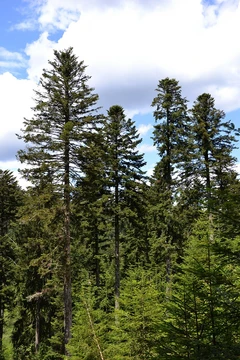
Pinus
Genus of conifers providing timber, pine nuts, and resin.

Pinus, commonly known as pines, is a genus of coniferous trees and shrubs in the family Pinaceae, and the sole genus in the subfamily Pinoideae. Pines are widely distributed across the Northern Hemisphere, dominating large areas of taiga and occurring in diverse habitats from the Mediterranean Basin to dry tropical forests in southeast Asia and Central America. They are among the most extensively used sources of timber, and their seeds (pine nuts) and resin are used in food and drink, such as pesto and retsina wine.
- field
- Botany
- known_for
- Providing one of the most extensively used types of timber; pine nuts used in dishes such as pesto; pine resin used to flavour retsina wine
Lore & Background
Pines are evergreen, coniferous resinous trees or rarely shrubs, growing 3–80 metres tall, with most species reaching 15–45 m. The smallest are Siberian dwarf pine and Potosi pinyon; the tallest is an 83.45 m sugar pine in Yosemite National Park. The spirals of branches, needles, and cone scales are arranged in Fibonacci number ratios. The bark of most pines is thick and scaly, but some species have thin, flaky bark. Branches are produced in pseudo-whorls. Pines have four types of leaf: seed leaves (cotyledons) in a whorl of 4–24; juvenile leaves, single and spirally arranged, produced for six months to five years; scale leaves, small and brown; and adult needles, bundled in fascicles of one to seven (usually two to five). Needles persist for 1.5–40 years depending on species. If a shoot's growing tip is damaged, needle fascicles just below can generate a stem-producing bud to replace the lost growth. Pines are monoecious, with male cones small (1–5 cm) and short-lived, and female cones taking 1.5–3 years to mature. Each cone scale bears two seeds. Seeds (pine nuts) are mostly small and winged, wind-dispersed; some are larger with a vestigial wing and bird-dispersed. In some species, seeds are stored in closed cones for many years until an environmental cue triggers opening—a phenomenon called serotiny, most commonly pyriscence, where resin binds cones shut until melted by fire.
Reader's Guide
Pines are a foundational genus in the Northern Hemisphere's boreal forests and other ecosystems, providing critical habitat and resources. Their economic importance is immense: pine timber is one of the most extensively used types of wood globally, while pine nuts are harvested for culinary uses such as pesto, and pine resin flavours retsina wine. Ecologically, many pines are fire-resistant or fire-dependent, with serotinous cones that release seeds after fire, allowing colonization of burnt ground with minimal competition. Taxonomically, pines are divided into two subgenera—Pinus (yellow or hard pines) and Strobus (white or soft pines and pinyons)—based on needle and cone characters. The highest species diversity is in Mexico. Pines have been introduced widely beyond their native range, with some species becoming naturalized or invasive. Their evolutionary history is complicated by hybridization, wind pollination, long life spans, and weak reproductive isolation, leading to complex genetic relationships.
Did You Know?
- Pines are monoecious, with male and female cones on the same tree; female cones take 1.5–3 years to mature.
- Some pines exhibit pyriscence, where resin binds cones shut until melted by fire, releasing seeds to colonize burnt ground.
Frequently Asked Questions
What is Pinus's primary role in the world?
Pines dominate enormous tracts of taiga and also colonize wildly different settings, from Mediterranean scrubland to arid tropical forests in southeast Asia and Central America. They rank among the most heavily harvested timber sources on the planet.
What are Pinus's signature contributions beyond wood?
The genus supplies pine nuts, a key ingredient in dishes like pesto, and a distinctive resin that gives retsina wine its characteristic flavor. These food-and-drink uses have made pines a culinary staple in several regional traditions.
More in Conifers 1-23
Spotted an error? Know more?
This is a living reference — every entry is fact-audited, and reader corrections feed straight into our audit queue. Suggest an edit · See this site's audit record