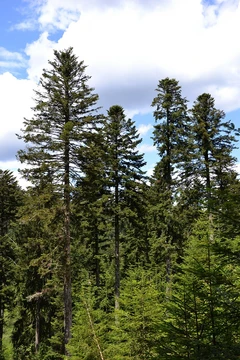
Sequoiadendron giganteum
Largest trees on Earth, endangered and ancient.

Sequoiadendron giganteum, also known as the giant sequoia, giant redwood, Sierra redwood, or Wellingtonia, is a species of coniferous tree in the family Cupressaceae, subfamily Sequoioideae. Giant sequoia specimens are the largest trees on Earth by volume, native to groves on the western slopes of the Sierra Nevada mountain range of California, though they have been introduced and grown around the world.
- trunk_diameter
- 6–8 m (20–26 ft)
- greatest_diameter_at_breast_height
- 8.8 m (29 ft) (General Grant tree)
- conservation_status
- Endangered (IUCN)
- native_range
- Western slopes of Sierra Nevada, California
Lore & Background
Endlicher derived it from the Latin sequi (to follow), referencing the mathematical sequence of seeds per cone. Giant sequoias grow to an average height of 50–85 m with trunk diameters of 6–8 m; the General Grant tree has the greatest diameter at breast height at 8.8 m. The wood is fibrous, brittle, and unsuitable for construction, used instead for fence posts or match sticks. The bark is fibrous, furrowed, and up to 90 cm thick at the base, containing tannic acid that provides fire protection. The leaves are evergreen, awl-shaped, and arranged spirally. The tree regenerates by seed; cones mature in 18–20 months but may remain closed for up to 20 years, with most seeds liberated by fire or insect damage.
Reader's Guide
Sequoiadendron giganteum is significant as the most massive individual tree species on Earth, with record heights exceeding 94 m and trunk diameters over 8 m. The species is adapted to fire, with fire-resistant bark and cones that open after fire, but it faces gradual decline in density since European settlement due to insufficient young trees. The giant sequoia is also a popular ornamental tree worldwide. Prehistorically, it was widespread across North America and Eurasia, with fossils found in Cretaceous sediments from North America, Europe, New Zealand, and Australia. Artificial groves have been planted, including one in the San Jacinto Mountains of Southern California, where trees are now reproducing naturally.
Did You Know?
- The General Grant tree has the greatest trunk diameter at breast height: 8.8 m (29 ft).
- The species was once widespread in North America and Europe, with fossils found in Cretaceous sediments as far as New Zealand and Australia.
Frequently Asked Questions
What is Sequoiadendron giganteum?
It is the giant sequoia, a coniferous tree in the Cupressaceae family (subfamily Sequoioideae) that goes by many common names, including giant redwood, Sierra redwood, and Wellingtonia. It is native to California but has since been planted in groves across the globe.
How big do giant sequoias actually get?
They are the largest living trees on Earth by volume, typically reaching 50–85 m in height with trunk diameters of 6–8 m. The record height stands at 94.8 m, and the widest known breast-height measurement is 8.8 m, held by the General Grant tree.
Where do wild giant sequoias grow?
Their natural range is limited to groves on the western slopes of the Sierra Nevada mountain range in California. Outside that core habitat, the species survives only in introduced plantings around the world.
More in Conifers 1-23
Spotted an error? Know more?
This is a living reference — every entry is fact-audited, and reader corrections feed straight into our audit queue. Suggest an edit · See this site's audit record