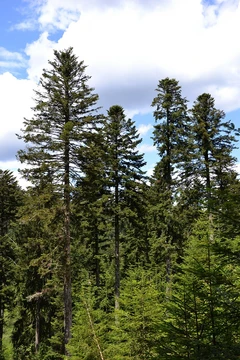
Thuja plicata
A large, long-lived conifer of great cultural and economic importance.

Thuja plicata, known commonly as western redcedar despite not being a true cedar, is a conifer from the cypress family native to the Pacific Northwest. It is the biggest member of the Thuja genus, capable of reaching 70 meters in height and 7 meters in trunk diameter, and can live for more than a thousand years. For Indigenous peoples of the region, the wood is used to construct canoes, totem poles, and tools, while the bark is turned into fiber for rope, baskets, clothing, and rain hats—making this tree culturally significant.
The tree’s trunk swells at the base and has shallow roots, with thin, gray-brown bark split into vertical bands. Open-grown specimens often have crowns that reach the ground, but in dense stands, foliage is limited to the top where light penetrates. As it ages, wind damages the crown, which is then replaced by less vigorous branches. The oldest verified individual lived 1,460 years. Its foliage forms flat sprays of scale-like leaves arranged in opposite pairs, each pair rotated 90 degrees from the last. These sprays are green with whitish stomatal bands underneath and give off a strong pineapple-like scent when crushed. Leaves range from 1 to 4 millimeters long on most sprays, though lead shoots can have leaves up to 12 millimeters. Branchlets turn orange-brown before dropping in autumn. Sunlit branches grow denser, overlapping foliage, while shaded ones spread more horizontally with less overlap.
Cones are slender, 10 to 18 millimeters long and 4 to 5 millimeters wide, with 8 to 12 thin, overlapping scales. They start green to yellow-green, ripen to brown about six months after pollination, and open to release seeds. Each seed is 4 to 5 millimeters long and 1 millimeter wide, with a narrow papery wing on each side. Pollen cones are 3 to 4 millimeters long, initially red or purple, and shed yellow pollen in spring.
The heartwood contains chemicals like plicatic acid, thujaplicatin methyl ether, hinokitiol, other thujaplicins, β-thujaplicinol, thujic acid, methyl thujate, 1,4-cineole, and γ-eudesmol. Plicatic acid is thought to be the main irritant causing allergic reactions and asthma in woodworkers exposed to the dust. Thujaplicins act as natural fungicides, preventing rot for about a century after the tree is cut. However, only older trees produce these compounds; saplings lack them and often develop rot early, sometimes leading to hollow trunks as the tree heals. Because of their fungicidal and anti-browning properties, thujaplicins are used in agriculture against fungal diseases and to prevent post-harvest decay. They are also potent chelating agents that bind divalent metal ions. Basic and animal studies suggest they may have antibacterial, antiviral, and antioxidant effects, but reliable evidence for these uses is still lacking.
Taxonomically, T. plicata is one of two North American Thuja species, the other being T. occidentalis. Nuclear genome analysis indicates a closer relationship to T. koraiensis from Korea, with the two likely diverging in the Miocene. A 2008 study found that coastal populations in Washington and Oregon are more genetically variable than those in the Rocky Mountains and coastal British Columbia, suggesting the species spread from a single southern refugium after the Last Glacial Maximum. Some studies proposed an inland refugium in central Idaho, but more recent genomic work supports only one refugium near the southern edge of its current range, with expansion northward and inland since then. Refugial populations may have experienced repeated bottlenecks during Pleistocene glacial maxima. Pollen cores show that T. plicata only became common in southern coastal British Columbia starting around that time.
- Scientific name
- Thuja plicata
- Family
- Cupressaceae
- Maximum trunk diameter
- 7 m (23 ft)
- Native range
- Pacific Northwest of North America
- Common names
- western redcedar, giant arborvitae, shinglewood
Lore & Background
Thuja plicata grows mostly in areas with a mild climate and plentiful rainfall, though it is sometimes present in drier areas where water is available year-round, such as wet valley bottoms and mountain streamsides. The species is shade-tolerant and able to establish in forest understories, and is considered a climax species. Its trunk swells at the base and has shallow roots; the bark is thin, gray-brown, and fissured into vertical bands. The foliage forms flat sprays with scale-like leaves that emit a strong aroma reminiscent of pineapple when crushed. The cones are slender, 10 to 18 mm long, with 8 to 12 thin, overlapping scales, and the seeds have a narrow papery wing.
Reader's Guide
Thuja plicata is significant for its wide range of uses and cultural importance. Indigenous peoples of the Pacific Northwest use its wood for canoes, totem poles, and tools, and its bark for rope, baskets, clothing, and rain hats. The wood is aromatic and rot-resistant, making it valuable for shingles and siding. The heartwood contains chemical substances such as plicatic acid and thujaplicins; plicatic acid is a contact allergen that can cause occupational asthma in woodworkers, while thujaplicins serve as natural fungicides that prevent rot for about a century after felling. Thujaplicins are also used in agriculture for fungal diseases and to prevent post-harvest decay. The species has been introduced to cool temperate areas in Northern Europe and New Zealand. Its taxonomy places it as one of two Thuja species native to North America, with genomic analysis suggesting a closer relation to T. koraiensis. Genetic studies indicate that after the Last Glacial Maximum, the species spread from a single refugium in the southern portion of its range, with pollen cores showing it became common in southern coastal British Columbia around 6,000 years ago.
Did You Know?
- The foliage emits a strong aroma reminiscent of pineapple when crushed.
- Thujaplicins in the heartwood act as natural fungicides that prevent rot for about a century after the tree is felled.
- The species name plicata means 'folded in plaits' or 'braided' in Latin, referring to the pattern of its small leaves.
Frequently Asked Questions
Who is Thuja plicata?
Thuja plicata, commonly called western redcedar, is a towering evergreen native to the forests of the Pacific Northwest. Despite its name, it belongs to the cypress family (Cupressaceae) rather than the true cedar group, and it is the biggest member of the Thuja genus.
What role does Thuja plicata play for Indigenous communities?
Pacific Northwest Indigenous peoples have relied on this tree for centuries, shaping its rot-resistant wood into canoes, totem poles, and everyday tools. They also strip and process the inner bark into a workable fiber used to weave rope, baskets, garments, and rain hats.
How does Thuja plicata's long story end?
There is no dramatic finale; the tree simply keeps growing for well over a millennium before eventually succumbing to age, storm damage, or disease. Its slow decay then feeds the forest floor that nurtures the next generation of seedlings.
Why is Thuja plicata considered so important?
It anchors the Pacific Northwest ecosystem as a keystone canopy species while simultaneously serving as one of the region's most economically valuable timber resources. Its combination of extraordinary size, longevity, and versatility in both natural and human contexts makes it a cornerstone of the local landscape.
More in Conifers 1-23
Spotted an error? Know more?
This is a living reference — every entry is fact-audited, and reader corrections feed straight into our audit queue. Suggest an edit · See this site's audit record