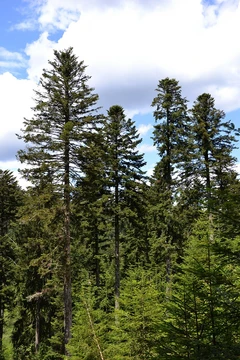
Tsuga canadensis
Long-lived conifer threatened by invasive adelgid.

Tsuga canadensis, commonly known as Canadian hemlock, eastern hemlock-spruce, or eastern hemlock, is a coniferous tree native to eastern North America. It is the state tree of Pennsylvania and is widespread throughout the Great Lakes region, the Appalachian Mountains, the Maritimes, and the Northeastern United States. The species has been introduced in the United Kingdom and mainland Europe as an ornamental tree.
- Scientific name
- Tsuga canadensis
- Common names
- Canadian hemlock, eastern hemlock-spruce, eastern hemlock, pruche du Canada
- Native range
- Eastern North America
- IUCN status
- Near Threatened
- Primary threat
- Hemlock woolly adelgid (Adelges tsugae)
Lore & Background
The trunk is usually straight and monopodial, with brownish, scaly, deeply fissured bark. The leaves are flattened, typically distichous, and measure 15 to 20 mm in length, with glaucous undersides featuring two stomatal bands. Seed cones are ovoid, 1.5 to 2.5 cm long. The wood is soft, coarse-grained, and light buff in color, used for general construction, crates, and railroad ties due to its ability to hold spikes. Historically, the bark was an important source of tannin for leather tanning. The tree is also a source of pulp for paper manufacturing. Eastern hemlocks are popular as ornamental trees, especially the mutated 'weeping hemlock' with drooping branches.
Reader's Guide
Tsuga canadensis holds significant ecological and economic importance in eastern North America. Its tolerance of shade, moist soil, and slopes makes it a dominant species in many forest ecosystems, particularly in the Appalachian Mountains and Great Lakes region. Infestations have caused widespread mortality, especially in the southern Appalachians, leading to its listing as Near Threatened on the IUCN Red List. Efforts to manage the adelgid include biological control using Laricobius nigrinus beetles, as well as active management in parks such as Kejimkujak National Park in Nova Scotia. The tree's decline also impacts the carbon cycle of affected forests. Historically, hemlock bark was vital for tannin in leather tanning, and its wood remains valued for construction and railroad ties.
Did You Know?
- Eastern hemlock wood is used for railroad ties because of its unusual power of holding spikes.
- The tree is the state tree of Pennsylvania.
Frequently Asked Questions
What is Tsuga canadensis?
Tsuga canadensis is a tall coniferous tree native to the eastern half of North America, most often called Canadian hemlock or eastern hemlock. It serves as the official state tree of Pennsylvania and is one of the most recognizable large conifers in northeastern woodlands.
Where does Tsuga canadensis grow in the wild?
You'll find it throughout the Great Lakes region, the Appalachian mountain chain, the Canadian Maritimes, and the broader Northeastern United States. Outside its native range it has been planted as an ornamental in the UK and across mainland Europe.
What is Tsuga canadensis's IUCN conservation status?
The IUCN currently classifies the species as Near Threatened, reflecting the mounting pressures it faces across its range. The designation signals that while it is not yet endangered, its long-term outlook warrants close monitoring.
What is the biggest threat to Tsuga canadensis?
The hemlock woolly adelgid, an invasive sap-feeding insect, is the primary driver of decline for this species across much of its range. Infestations can kill mature trees within just a few years, making it the single most serious conservation concern for the genus.
More in Conifers 1-23
Spotted an error? Know more?
This is a living reference — every entry is fact-audited, and reader corrections feed straight into our audit queue. Suggest an edit · See this site's audit record